Bulk Water Fill Stations: 9 Essential Things City Water Departments Should Know Before Buying
A buyer’s guide for municipal water departments evaluating a cashless, RFID-enabled fill station — manufactured in Akron, Ohio.
Key Takeaways
- A bulk water fill station is an unattended, metered dispensing point that lets haulers and contractors buy potable or non-potable water and pays the owner for every gallon.
- Before buying, evaluate metering accuracy (legal for trade), payment options, weather protection, remote monitoring, and revenue accounting.
- Cashless, RFID/EMV stations recover the revenue that coin-op and open standpipes lose to theft and unmetered draws.
- Pro-Tech Systems Group builds American-made cashless bulk water fill stations for eastern-US municipalities.
Most municipal bulk water fill stations in service today still take cash, lose revenue to broken coin counters, and tell the operator almost nothing about who used the water or when. Replacing one of those units, or installing a new one for a township that doesn’t have one yet, is a five-figure procurement decision — and the wrong choice creates a maintenance headache that lasts a decade. This guide walks through the nine features that actually matter when a city water department, utility authority, or township public-works office evaluates a modern bulk water fill station.
Pro-Tech Systems Group designs and builds cashless bulk water fill stations in Akron, Ohio. The points below come from the questions municipal buyers ask before they sign a purchase order — what to look for, what to avoid, and where most older stations fall short.
What a bulk water fill station actually does
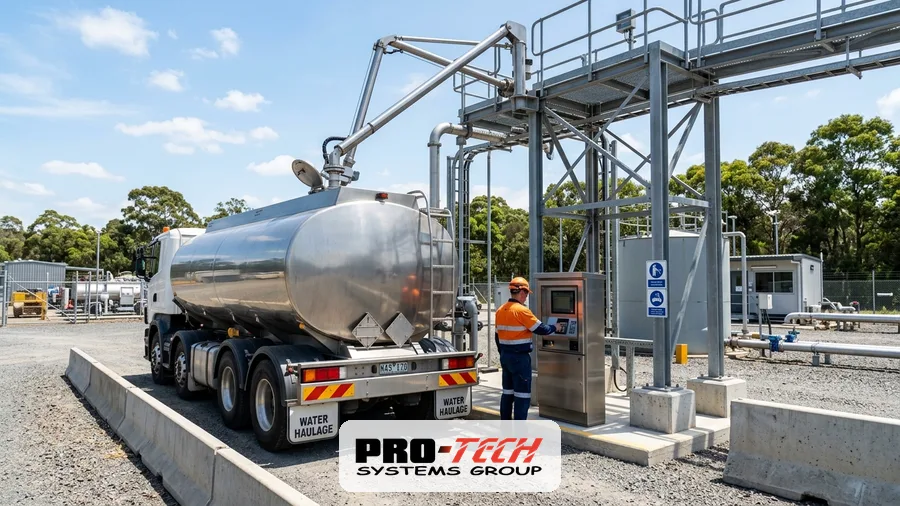
A bulk water fill station is an unattended dispensing point where authorized users — usually contractors, fleet operators, fire departments, agricultural haulers, or other municipalities — can buy potable water by the gallon from a city or utility’s distribution system. The user pulls up with a tanker truck, identifies themselves at the panel (card, RFID, or account login), and the station meters the flow and charges accordingly.
Older units rely on coin slots, paper logs, or staff-issued tokens. Modern units use the same payment rails as a retail point-of-sale terminal, talk back to the utility’s billing system over cellular or Wi-Fi, and lock down both physical and cyber access. The result: less revenue leakage, less staff time spent on reconciliation, and an audit trail that holds up when the public-works director gets asked where the money went.
9 Things to Evaluate Before Buying
1. Accepted payment methods
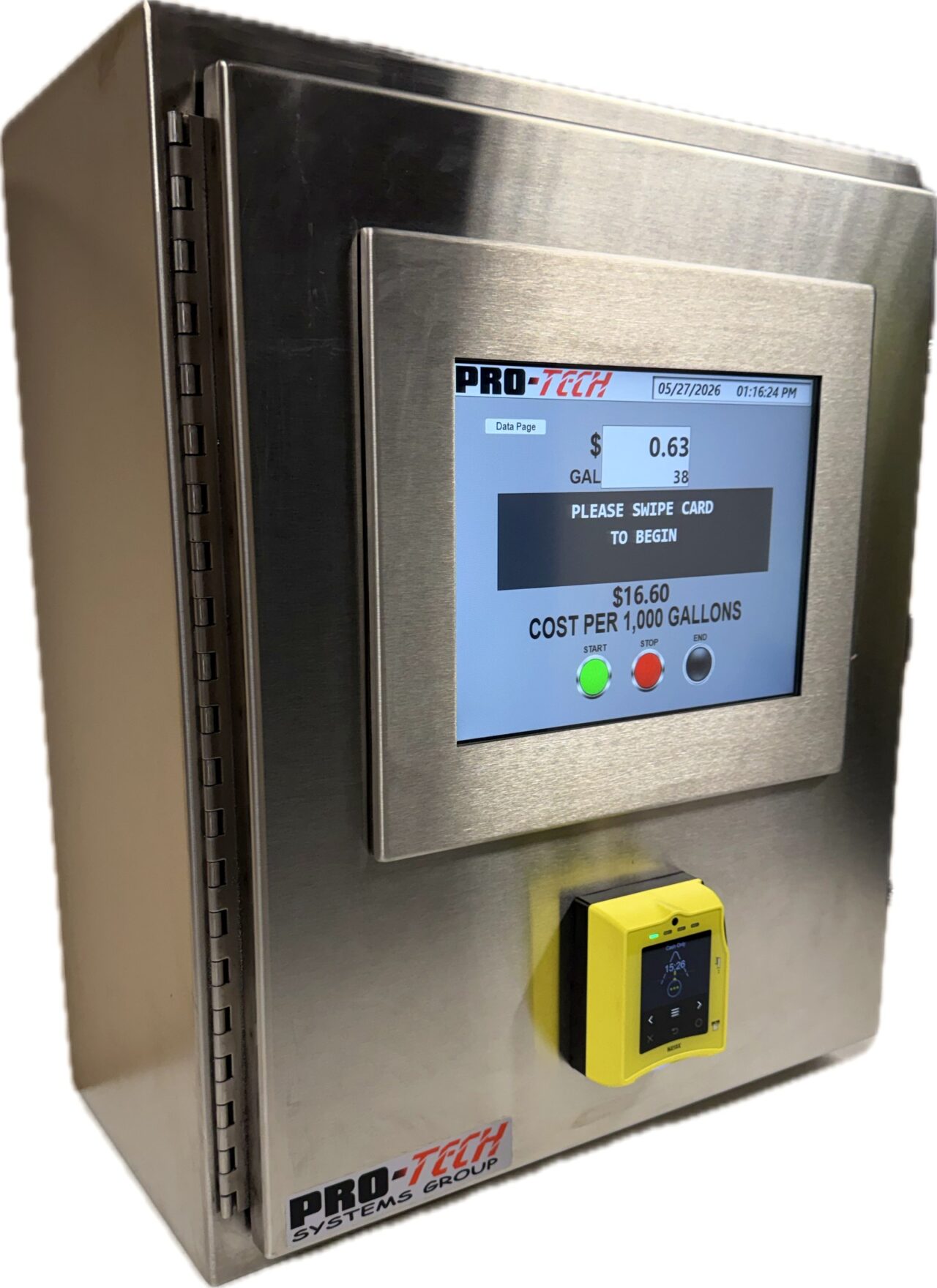
A current-generation bulk water fill station should accept at minimum EMV chip and contactless credit/debit cards (Visa, Mastercard, Discover, American Express), mobile wallets (Apple Pay, Google Pay, Samsung Pay), and an RFID card or fob for repeat fleet users. The combination matters: contractors with their own card prefer credit, but in-house DPW crews and contracted haulers tend to use RFID because it’s faster and ties cleanly to a department account.
Ask the vendor specifically about EMV compliance. Magnetic-stripe-only readers are no longer PCI compliant for new installations, and a station that can’t process a tap will lose transactions every week.
2. Cashless versus coin-op revenue protection
Cash-handling is the single largest source of revenue leakage on legacy stations. Coin jams, vandalism, and the cost of armored pickup all eat into the per-gallon margin. A 2023 American Water Works Association field survey of municipal bulk fill operators reported that operators replacing coin-only units with cashless systems typically recover two to four percent of gross revenue within the first year — money that was previously lost to mechanical issues and unrecorded transactions.
Going cashless also removes the cash drawer as a vandalism target. Stainless-steel enclosures with no coin slot are a much less appealing object for someone with a pry bar.
3. Real-time usage tracking and payout schedule
This is the feature that closes the deal with finance departments. A networked bulk water fill station logs every transaction — user, gallons dispensed, price, date, time — and pushes it to the vendor’s accounting platform in real time. Pro-Tech’s stations, for example, route all usage data through PTSG’s managed billing service, and the utility receives consolidated payouts on a monthly, quarterly, or annual schedule of their choice, with line-item reporting attached.
For a small township, that means no extra accounting headcount. For a larger utility, it means the data flows straight into the existing ERP without an integration project. Ask any vendor exactly what their reporting cadence looks like and whether the utility owns the raw transaction data.
4. SCADA integration
Most water and utility departments already run a SCADA system for distribution monitoring, pump control, or tank-level management. A modern bulk water fill station should be able to integrate as another endpoint — feeding flow totals, pressure readings, and operational status into the same HMI the operators already watch. Common protocols to ask about include Modbus TCP, EtherNet/IP (Rockwell-style), and OPC UA.
The benefit is operational, not just nice-to-have. When the fill station’s flow drops because of a pressure issue upstream, the operator sees it on the same dashboard as the rest of the distribution network instead of finding out from an angry contractor an hour later. (See our deeper write-up on AI applications in modern SCADA systems for the integration patterns we use most.)
5. Weatherproof and vandal-resistant enclosure
The station lives outdoors year-round. Specifications to confirm: NEMA 4X-rated stainless-steel enclosure (the “X” matters — it’s the corrosion-resistant rating that handles winter road salt in the northeast), lockable hinged door, recessed touchscreen with anti-glare coating, and tamper-resistant fasteners. The enclosure should be cold-rated to at least -20°F if the station is being installed anywhere north of the Mason-Dixon line.
The card reader and screen are the two failure points to scrutinize. A reader with an exposed magstripe slot collects dirt and salt; a flush-mount contactless reader doesn’t.
6. Remote price adjustment and monitoring
When the water rate changes — and it will — the operator should be able to push the new price-per-1,000-gallons from a browser, not from the panel itself. Same with operating hours, user account changes, and out-of-service alerts. A station without remote management means a truck roll for every rate update, every account add, and every diagnostic check.
Ask whether the management portal is hosted by the vendor (managed) or on-prem (the utility’s IT department maintains it). Both work; the question is which one your IT environment is set up to support.
7. Retrofit versus new install considerations
Many municipalities aren’t starting from scratch — they have an existing dispensing pipe, hydrant, or older station and want to modernize the user-facing panel without rebuilding the whole point of connection. A well-designed control panel ties into existing valves and flow meters with standard pipe-thread fittings and 4-20 mA or pulse inputs from the meter. The civil work doesn’t need to be redone.
If the existing site has utility power and a network drop within 100 feet, retrofit is usually 30-40% cheaper than a full new install and takes one day on site instead of a full week.
8. Compliance and federal funding eligibility
Many municipal water projects are funded through the EPA’s Clean Water State Revolving Fund or Drinking Water State Revolving Fund (DWSRF), or through ARPA water-infrastructure allocations. Funding programs that draw on federal money usually carry Buy American Act and Build America, Buy America (BABA) requirements — meaning the iron, steel, and manufactured products in the installation must be produced in the United States.
Confirm the vendor’s manufacturing location and whether they can provide a BABA compliance certification on request. A station built outside the US can disqualify the entire project from grant funding, even if it’s the only non-domestic component.
9. Local support and service coverage
A station that breaks on a Saturday and waits until Tuesday for a parts shipment loses a weekend of revenue and creates a contractor pile-up at the next nearest dispensing point. Service response time and parts inventory location are not glamorous specifications, but they are what determines whether the station runs 99% of the year or 95%.
Ask the vendor where their nearest technician and spare-parts inventory are physically located relative to the project site. For municipalities in the eastern half of the US, an Ohio-based manufacturer with same-day parts shipping and on-site service available within 24-48 hours is meaningfully different from a vendor whose nearest hub is two time zones away.
How 3 Public Bulk Water Fill Stations Handle Municipal Access
Most cities don’t talk publicly about what equipment they bought, but several utilities publish detailed pages describing how their bulk water fill program works. The three programs below are useful market references — they show what end users expect from a modern station and what the procurement priorities look like.
Erie Water Works (Erie, PA) runs a public bulk water fill station for commercial haulers operating in northwest Pennsylvania. The program publishes user account requirements, daily operating hours, and per-gallon pricing — the kind of public-facing transparency a cashless station’s management portal makes easy to maintain.
Northwest Wisconsin Water and Sewer District operates unattended bulk water stations for rural haulers and contractors who serve customers outside the district’s pipe network. The model — small utility, dispersed user base, low staff-touch — is exactly the case a cashless station addresses best.
City of Grand Junction, Colorado runs a bulk water fill station program for landscapers, construction contractors, and water haulers. The city’s page documents the account-creation workflow, the dispensed-volume reporting available to users, and the rate schedule — all features that flow directly out of a networked station’s billing platform.
These programs are cited as illustrative public references and are not represented as Pro-Tech Systems Group installations.


Why Municipalities Are Moving Away from Coin-Op Systems
The shift to cashless bulk water fill stations is not driven by one factor but by three converging pressures.
First, the cash-handling problem. Coin mechanisms jam, get stuck open, get vandalized, or simply wear out — and every failure means lost revenue plus a truck roll. Public-works directors who have run the numbers usually find that the embedded maintenance cost of a coin station over a 10-year life exceeds the price difference of a cashless unit at purchase.
Second, the accountability problem. State auditors and ratepayer advisory boards increasingly expect line-item documentation of bulk-water revenue. A cashless station with networked reporting produces that documentation automatically. A coin station produces a stack of paper logs.
Third, the user experience problem. Commercial haulers — the customers municipalities actually want to keep — strongly prefer tap-to-pay or RFID over hunting for quarters. A station that’s painful to use generates complaints to the city council. A station that takes a card or a fob doesn’t.

How to Start the Procurement Conversation
The fastest path for a city, township, or utility evaluating a new or replacement bulk water fill station is to start with three questions internally before talking to vendors:
- Site status — is this a retrofit of an existing dispensing point, a new install, or a fleet of multiple sites?
- Funding source — is the project drawing on federal money (SRF, ARPA) that carries Buy American requirements?
- Reporting needs — does the utility need transaction data pushed to an existing accounting system, or is a managed billing service with consolidated payouts a better fit?
With those answers in hand, the conversation with vendors moves much faster. Pro-Tech Systems Group has built and serviced bulk water fill stations for municipal water and utility departments across the eastern United States since 1986. Our cashless/EMV bulk water station is built in Akron, Ohio, ships with BABA-compliant documentation, and integrates with most existing SCADA platforms.
Frequently Asked Questions
How much does a cashless bulk water fill station cost?
A full new install — control panel, enclosure, payment hardware, flow meter, valves, and remote-management setup — typically falls in the $25,000 to $60,000 range depending on flow rate, enclosure size, and site civil requirements. Retrofits of existing dispensing points are generally 30-40% lower. Pricing varies enough by site that the only useful number comes after a brief site review.
Can we retrofit our existing bulk water dispenser?
Yes, in most cases. If the existing site has utility power, a network connection within reach, and a working flow meter with pulse or 4-20 mA output, the control panel can be swapped without rebuilding the dispensing point. Retrofits typically take one day on site.
How does PTSG handle billing and revenue payouts?
Every transaction is logged in real time and routed through Pro-Tech’s managed billing platform. The utility chooses the payout schedule — monthly, quarterly, or annually — and receives consolidated payouts with full line-item reporting. The utility owns the raw transaction data and can pull it on demand.
Will it integrate with our SCADA system?
Yes. Pro-Tech’s bulk water fill stations expose flow, pressure, and operational status over Modbus TCP, EtherNet/IP, or OPC UA. The station appears as another endpoint in the utility’s existing HMI.
Is the system eligible for federal grant programs?
Pro-Tech bulk water fill stations are manufactured in Akron, Ohio, and ship with Build America, Buy America (BABA) compliance documentation on request. This makes the station eligible for use in projects funded through the EPA’s Clean Water State Revolving Fund, Drinking Water State Revolving Fund, and ARPA water-infrastructure allocations.
What kind of warranty and service coverage is included?
Stations ship with a one-year parts-and-labor warranty as standard, extendable. Service technicians cover the eastern half of the US with 24-48 hour on-site response. Spare parts ship same-day from Akron.
More Questions About Bulk Water Fill Stations
How much does a bulk water fill station cost?
A complete cashless bulk water fill station control package from Pro-Tech Systems Group is approximately $28,000, which includes the control valve, flow meter, and startup service. Installation is performed by the municipality's own licensed electrician and plumber, so total project cost depends on site conditions.
How long does it take to get a bulk water fill station?
Typical lead time is 14 to 18 weeks in total, including the engineering submittal process; the control panel build alone runs about 8 weeks. Planning the procurement and submittal early keeps the project on schedule.
Is the metering accurate enough to bill customers?
Yes. A properly specified station uses a flow meter certified “legal for trade,” the standard municipalities need to charge for water by volume, so every gallon is measured and billable.
Talk to Pro-Tech About Your Bulk Water Fill Station
Whether you’re modernizing an existing dispensing point or building a new site from scratch, the fastest way to get accurate specs and pricing is a 15-minute phone call.
Call (330) 773-9828
Related posts