Digital Oilfield Solutions: 7 Proven Ways Operators Cut Cost and Downtime in 2026
The phrase “digital oilfield” has been used and abused for almost two decades. What changed in 2026 is who is paying for it and what they are paying for. Independent producers in the Permian, Bakken, and Eagle Ford are no longer chasing flashy dashboards. They are buying digital oilfield solutions that show up on the production report as fewer truck rolls, fewer flared volumes, and fewer surprise workovers.

Below are the seven highest-ROI digital oilfield solutions our integration team is deploying for upstream and midstream operators this year, the rough payback periods we are seeing, and the mistakes that wipe out those returns.
What is a digital oilfield, in 2026 terms?
Digital oilfield solutions connect field equipment (wellheads, separators, tanks, pumps, compressors, flares) to a central control room or cloud platform, enabling operations, engineering, and accounting to work from the same live data. The four building blocks are:
- Instrumentation. Pressure, level, flow, vibration, and temperature sensors at each wellsite and gathering point.
- Edge controllers. RTUs, EFM flow computers, and PLCs that handle local control, alarm logic, and gas measurement.
- Communications. Licensed and unlicensed radio, cellular LTE/5G, and increasingly LEO satellite backhaul.
- SCADA and analytics. A central host (on-prem or cloud) that aggregates the data, runs alarm management, and feeds reporting and machine learning models.
The shift from 2018 to 2026 is that all four layers are now expected to interoperate over open protocols (OPC UA, MQTT, Sparkplug B, ISA-95) rather than proprietary stacks. That single change unlocks the remaining use cases below.
1. Plunger lift optimization
Plunger lift is the most common artificial lift method for aging gas wells and is also the most under-tuned. A digital plunger controller with surface and downhole pressure feedback adjusts cycle times automatically based on liquid loading, casing pressure rebuild, and tubing pressure decay. Operators replacing fixed-time controllers with optimized digital plungers typically report:
- 5 to 12 percent gas production uplift on declining wells
- 30 to 50 percent fewer “plunger no-arrival” alarms per month
- One to three fewer slickline trips per well per year
Payback runs three to nine months per well at current gas prices.
2. Remote tank level and custody transfer
Open-channel guided-wave radar on lease tanks combined with EFM custody transfer at the LACT unit gives both the operator and the midstream offtaker the same numbers in real time. The business case shows up in three places: fewer “tank ran over” environmental incidents, fewer overflow-truck calls, and almost zero ticket disputes with the gatherer. Our deeper look at oil and gas SCADA solutions walks through a typical LACT integration architecture.
3. Compressor and pump predictive maintenance
Vibration, oil temperature, and discharge pressure are the three signals that detect most reciprocating compressor failures days before they lead to unplanned shutdowns. A modest vibration-monitoring package at a midstream compressor station (think four to eight $1,500 wireless sensors per skid) feeds into a cloud-based anomaly model that flags valve-seat wear, rod-packing leaks, and bearing-wipe events.
Most operators we work with report a 15-25% reduction in unplanned compressor downtime within the first 12 months. The trick is to make sure the model output appears on the operator’s alarm screen, not buried in an engineer-only dashboard. Predictive maintenance only works when it triggers a work order.
4. Methane emissions monitoring
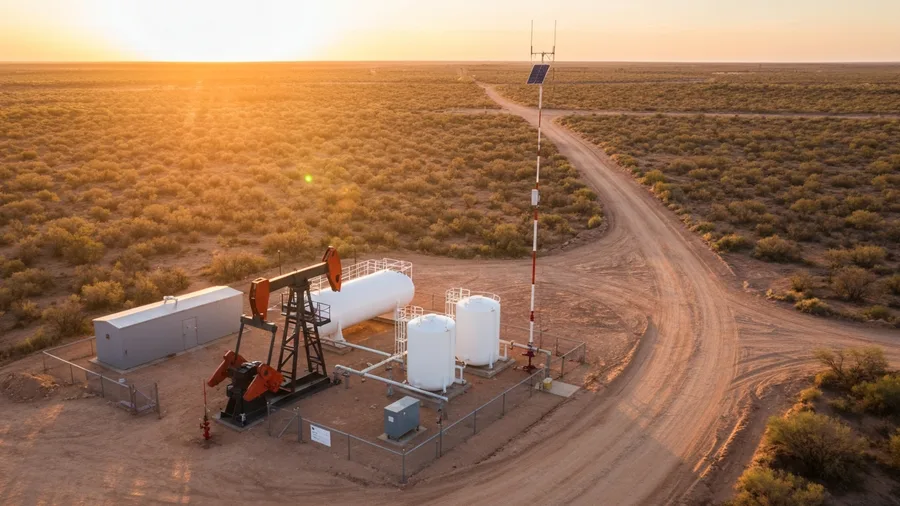
EPA’s revised Subpart W and OOOOb rules are now in full effect for 2026 reporting. Operators are deploying continuous methane sensors at tank batteries, dehydrators, and compressor stations to replace or supplement quarterly OGI surveys. The current standard stack:
- Solar-powered laser-based methane point sensors at high-risk emission sources
- A site-edge data logger that timestamps detections against process events
- A cloud platform that auto-generates emissions reports in EPA-acceptable format
Beyond compliance, the operational payback is meaningful. Sensors regularly catch leaking thief hatches and stuck valves that would otherwise vent for weeks.
5. AI-assisted production surveillance
AI surveillance was overhyped in 2022 and 2023. In 2026, the working pattern is narrow and effective: a machine-learning model trained on each well’s normal pressure, flow, and temperature signature flags anomalies that a human operator confirms or dismisses. Over time, the model learns which alarms matter and reduces operator-fatigue-driven misses.
The integrators delivering real value here are pairing the model with the existing SCADA alarm management discipline outlined in our ISA-18.2 alarm management guide. Without that foundation, ML adds noise instead of removing it. For a wider look at how AI fits into industrial control, see our AI in SCADA article.
6. Pipeline leak and theft detection
Mass-balance leak detection (compensated volume in vs. volume out) combined with rate-of-change pressure analysis remains the most reliable digital tool for gathering and transmission lines. Newer fiber-optic distributed acoustic sensing (DAS) systems are also moving from pilot to production on critical export pipelines, detecting digging activity hundreds of meters from the line. Our overview of pipeline SCADA best practices covers the API 1130/1149 compliance angle in more depth.
7. Edge-to-cloud architecture and data governance
Every solution above generates data that has to go somewhere. The architectural trend that finally stuck in 2025 and 2026 is edge-first, cloud-second. Local controllers run the time-critical logic, an edge gateway buffers and contextualizes data, and only curated tags stream to the cloud. The benefits:
- Bandwidth costs stay sane on cellular and satellite links
- Plant operations keep running when the WAN is down
- Engineering and accounting share one source of truth on lease data
Open standards make the architecture portable. OPC UA over MQTT with Sparkplug B is the protocol stack most new digital oilfield solutions projects in 2026 are specifying, and it is supported by the ISA and the OPC Foundation.
The mistakes that kill digital oilfield ROI
For every operator getting clear payback on digital oilfield investment, another is sitting on shelfware. The patterns we see most:
- Buying analytics before fixing alarm management. An operator buried in nuisance alarms will not act on an ML insight, no matter how accurate it is.
- Treating cybersecurity as an afterthought. Remote-access trojans on field RTUs are real. The CISA ICS guidance on segmented OT networks is no longer optional.
- Ignoring the field tech who has to maintain it. A solar-powered methane sensor that needs a laptop to recalibrate at -10°F will be uninstalled within a year.
- Buying eight different cloud platforms. Each acquisition or new vendor adds another login, another data silo, and another integration project. A unified historian or unified namespace strategy avoids the trap.
- Skipping change management. The biggest ROI lever, operators actually using the new screens and workflows, is also the easiest to underfund.
What a realistic digital oilfield solutions roadmap looks like
A typical mid-size E&P with 200 to 800 wells and a handful of compressor stations does not need to do all seven items in year one. A realistic three-year roadmap:
Year 1. Standardize on one SCADA host. Migrate or upgrade RTUs at the top 20 percent producing wells. Please get the tank levels and gas measurement cleaned. Establish an alarm rationalization process.
Year 2. Deploy plunger optimization on candidate wells. Roll out compressor vibration monitoring on the most critical 30 percent of stations. Implement continuous methane monitoring at top-emitting sites ahead of the EPA reporting deadline.
Year 3. Add AI surveillance on a few high-value pads. Move historian to an edge-to-cloud architecture. Open the data set to the production engineering and accounting teams, with a controlled data governance layer in place.
Done in that order, the program funds itself by the end of Year 1 and compounds from there.
The bottom line
Digital oilfield solutions that work in 2026 are the unglamorous ones: better alarm hygiene, optimized plunger cycles, clean tank levels, continuous emissions monitoring, and a clear edge-to-cloud architecture. Operators who chase these wins systematically are running leaner than competitors, trying to skip straight to AI. The technology is mature; the engineering discipline is the differentiator.
Pro-Tech Systems Group integrates SCADA, RTUs, and edge platforms across upstream and midstream oil and gas across the U.S. If you are scoping a digital oilfield solutions initiative for the next CapEx cycle and want a system-integrator perspective on what is actually delivering payback, our team is happy to share lessons learned. Contact us to set up a working session.