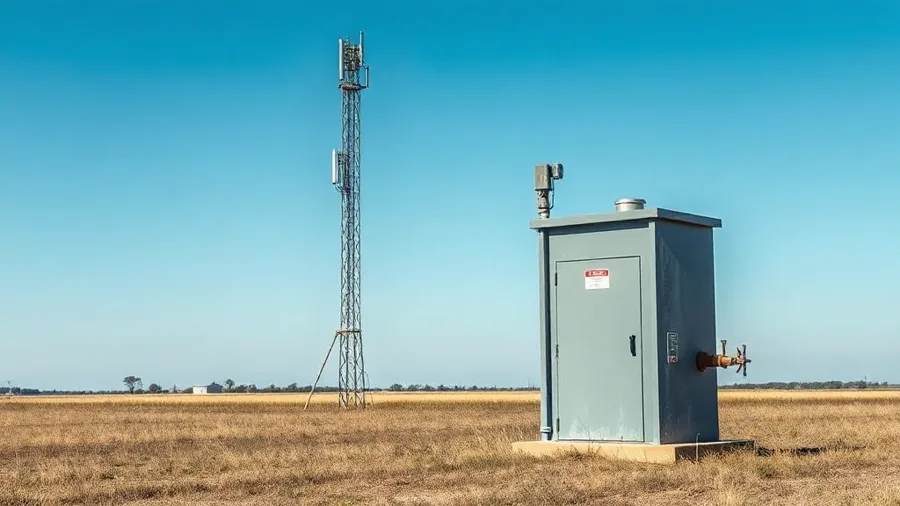
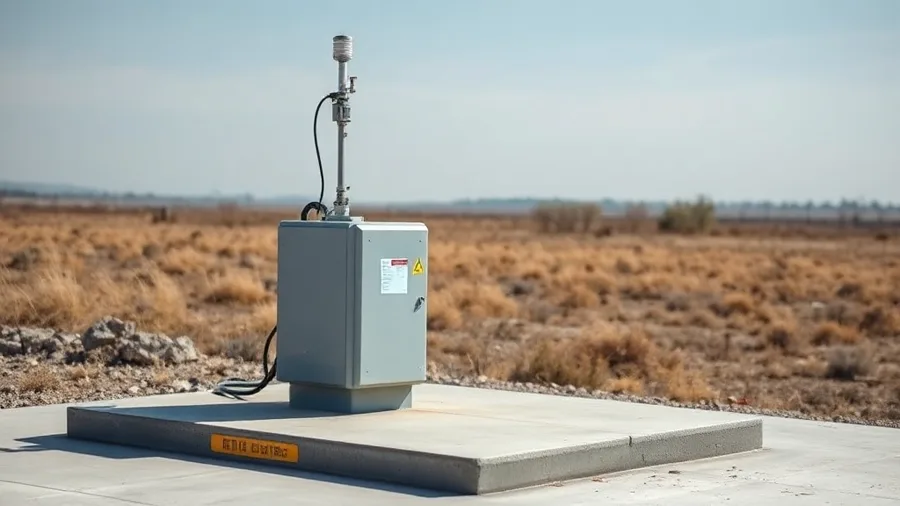
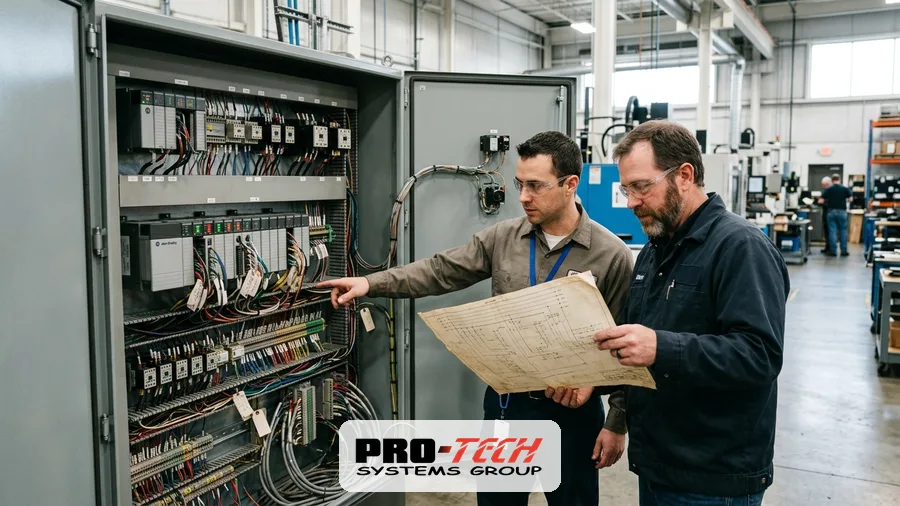
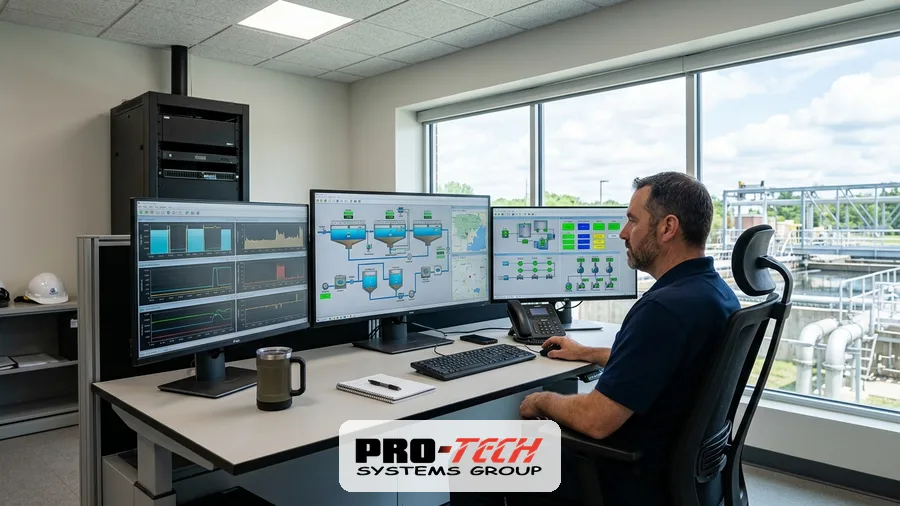
For decades, the way to get data back from a remote pump station, lift station, well head, or tank farm was a licensed radio link. It worked, the hardware was paid for years ago, and nobody wanted to touch it. But the radios that have run those sites since the 1990s are reaching the end of their service life at the same time that an industrial cellular modem has become cheaper, faster, anrequires time and incurs frequency coordination,d easier to support than the radio network it replaces. For most utilities and operators in the eastern United States, the math has flipped.
This article lays out where radio telemetry runs into walls, how cellular compares head to head, and the seven reasons operators are making the switch. It also covers the honest exception — the sites where you should keep the radio — and what a migration actually involves.
Why remote-site radio telemetry is hitting a wall
Licensed point-to-point and point-to-multipoint radio still does one job well: it moves small amounts of SCADA data over long distances with no recurring carrier fee. The problems are everywhere else.
Spectrum is the first. Usable licensed frequencies in the 450–470 MHz and 900 MHz bands are congested, and the FCC Part 90 licensing process for a new or modified link takes time and frequency-coordination fees. Add a site and you may be adding a repeater tower to clear a ridgeline or tree canopy.
Then there is the hardware itself. Master-station radios, repeaters, and RTU radios from the late ’90s and 2000s are going obsolete. Spare boards are scarce, the engineers who tuned the network are retiring, and a single failed repeater can blind a dozen downstream sites at once. Bandwidth caps out at a few kilobits per second on older links, which is fine for a flow total but useless if you want camera snapshots, vibration data, or a richer poll.
Radio vs. cellular telemetry: a side-by-side comparison
Factor
Licensed radio telemetry
Industrial cellular modem
Licensing
FCC license + frequency coordination
None (carrier-managed spectrum)
Infrastructure
Towers, repeaters, antennas you own and maintain
Carrier network; antenna at site only
Bandwidth
~1–19.2 kbps typical on legacy links
Mbps-class LTE/5G
Coverage gaps
Line-of-sight; needs repeaters
Wherever the carrier has signal
Deployment time
Weeks to months
Hours to days
Security
Obscurity + proprietary protocol
Private APN, VPN, SIM-based auth
Recurring cost
Low (no carrier fee)
Monthly data plan per site
Failure blast radius
A repeater outage drops many sites
One site drops, others unaffected
The one column where radio still wins is the recurring fee. Everything else now favors cellular telemetry — and as you will see below, the lifecycle cost usually erases the data-plan disadvantage.
The 7 reasons operators move to an industrial cellular modem
1. No FCC licensing or repeater towers
A cellular link uses carrier-managed spectrum, so there is no license to file, no frequency coordination, and no repeater to build and maintain. You remove an entire category of owned infrastructure from your balance sheet.
2. Bandwidth for richer SCADA data
LTE and 5G give you headroom that a legacy radio cannot. The same modem that polls a flow total can carry pump vibration trends, water-quality analyzers, energy submetering, and camera images without choking. That bandwidth makes modern IIoT data collection practical at sites that previously sent only sites head-to-heada handful of registers.
3. Faster deployment
A new remote site goes live in hours, not the weeks a licensed radio path requires. Mount the antenna, insert the SIM, configure the APN, and the RTU is reporting. For emergency or temporary sites, that speed is the whole argument.
4. Remote diagnostics and over-the-air configuration
A modern industrial cellular modem reports its own signal strength, connection state, and data usage, and accepts configuration changes over the air. You troubleshoot from the office instead of dispatching a truck to a site two hours away to find out the antenna cable was loose.
5. Private APN and VPN security
This is where cellular has quietly pulled ahead of radio. With a carrier private APN, your remote sites never touch the public internet — they ride a closed path back to your SCADA network, with SIM-based device authentication and an IPsec or OpenVPN tunnel on top. That aligns with the segmentation guidance in the CISA recommended practices for industrial control systems, which legacy radio’s security-by-obscurity does not satisfy.
6. Redundancy and failover
Cellular sites fail independently. There is no shared repeater whose outage takes down a region. For critical sites,a you can add dual-SIM or dual-carrier failover so the RTU rolls to a second network if the primary drops — a level of resilience that is expensive to build into a private radio system.
7. Lower lifecycle cost
This is the reason that surprises people. Once you add up obsolete-radio replacement, tower and repeater maintenance, FCC fees, and the truck rolls a non-diagnostic network forces, the owned radio system usually costs more over teobsolete radio replacement, tower and repeater maintenance, FCC fees, and the truck rolls a non-diagnostic network forces, the owned radio system usually costs more over 10n years than cellular data plans do — even before counting the staff time cellular gives back.
Where cellular isn’t the answer
Cellular is not a universal replacement, and a vendor who tells you it to youit is should make you nervous. If a site sits in a genuine carrier dead zone — deep in a watershed, behind terrain, or far from any tower — radio or a hybrid design is still the right call. The same goes for sub-second control loops that cannot tolerate carrier latency, and for sites where an existing radio network is healthy, fully spared, and has years of life left.
The honest approach is a coverage check before anything else. A short cellular site survey at each location tells you the real signal strength and which carrier wins, so you migrate the sites that benefit and leave the ones that don’t. Often the answer is a phased migration: move the sites with poor radio coverage or obsolete hardware first, keep the rest until they age out.
What a remote-site migration actually involves
A typical conversion follows four steps:
Site survey — verify signal strength and best carrier at each location; identify antenna type (often a directional Yagi for fringe sites).
Carrier and APN setup — provision SIMs on a private APN tied to your SCADA network.
Modem and RTU — install the industrial cellular modem, wire it to the existing RTU or PLC, and configure the polling.
SCADA poll testing — confirm the master station sees the site, tune poll rates and timeouts, and document the new path.
Most of the field work reuses the existing RTU, panel, and instrumentation. You are swapping the communications layer, not rebuilding the site, so the cost and disruption are far lower than a station rebuild. In a phased rollout, the first industrial cellular modem you install becomes the template — once the APN, VPN, and SCADA poll settings are proven at one site, every subsequent site reuses that known-good configuration and goes faster. Our broader approach to remote site connectivity and telemetry covers the private-cellular, hybrid, and site-survey options in more depth.
Frequently asked questions
Is an industrial cellular modem secure enough for SCADA?
Yes, when it is deployed correctly. A private APN keeps remote sites off the public internet, SIM-based authentication ties each device to your account, and a VPN tunnel encrypts the link end to end. That is a stronger posture than the proprietary-protocol obscurity most radio networks rely on.
What happens at sites with weak cellular coverage?
A site survey identifies them before you commit. Fringe sites can often be brought up with a directional antenna; true dead zones stay on radio or use a hybrid design. The point of the survey is to avoid migrating a site that cellular cannot reliably serve.
Should we use public or private cellular?end-to-endprivate cellular, hybrid, and site survey options in greater
For SCADA, private — a carrier private APN, or a private LTE/5G/CBRS network for larger campuses. Public cellular works for low-risk monitoring, but anything tied into control should stay on a private, segmented path.
How much does the monthly data plan cost?
Industrial SCADA sites move very little data, so plans are typically a few dollars per site per month on a pooled IoT account. That recurring fee is the main cost cellular adds — and it is usually smaller than the radio maintenance and truck rolls it removes.
Talk to Pro-Tech about your remote sites
Pro-Tech Systems Group has designed and supported remote-site communications for water, wastewater, and oil & gas operators across the eastern US since 1986. If your radio network is aging or you are adding sites, the fastest way to know whether cellular fits is a short coverage assessment.
Call (330) 773-9828 or request a remote-site connectivity assessment.