Key Takeaways for Industrial PLC Upgrades
- Executing timely PLC upgrades protects municipal water facilities and manufacturing plants from catastrophic unplanned downtime caused by obsolete, discontinued control hardware.
- Relying on unauthorized online surplus brokers for replacement processors like the Allen-Bradley PLC-5 or SLC 500 introduces counterfeit components and unvetted firmware vulnerabilities.
- Modern 1492 wiring conversion systems allow engineers to complete I/O migrations without lifting a single field wire, reducing cutover windows from weeks to hours.
- Phased migration frameworks allow plant managers to modernize processor hardware and industrial networking first, deferring I/O replacement to routine scheduled turnarounds.
- Partnering with an independent, certified Rockwell Automation Silver Tier system integrator guarantees clean documentation, editable source code, and zero vendor lock-in.
Executing planned PLC upgrades is one of the most critical risk-management decisions an industrial plant manager or municipal utility director will ever make. Programmable logic controllers are the silent workhorses of modern infrastructure, quietly governing chemical feeds, pump stations, conveyors, and high-speed assembly lines for decades. However, when legacy platforms reach the end of their manufacturer lifecycle, continuing to run them transforms a reliable operational asset into a ticking liability.
Across Ohio and the Midwest, hundreds of municipal water facilities and heavy manufacturing plants still rely on vintage Allen-Bradley PLC-5, SLC 500, and MicroLogix platforms installed in the 1990s. While these rugged workhorses served admirably for thirty years, manufacturer technical support has ceased, spare parts are discontinued, and modern SCADA networks cannot natively communicate with antique Data Highway Plus (DH+) or Remote I/O (RIO) serial protocols.
Waiting for a catastrophic hardware failure before scoping PLC upgrades is a recipe for weeks of unbudgeted downtime. This comprehensive guide outlines the seven proven engineering strategies industrial facilities use to modernize obsolete control systems cleanly, cost-effectively, and with zero unplanned downtime.
Why Industrial Facilities Prioritize PLC Upgrades in 2026
The primary reason plants initiate PLC upgrades is the total elimination of component obsolescence risk. When a legacy processor fails on an active production line, the plant faces immediate supply chain paralysis. Discontinued power supplies and analog input cards cannot be purchased through authorized distribution channels. Sourcing unvetted surplus hardware from secondary brokers carries massive risks: dried electrolytic capacitors, damaged backplane traces, and unverified firmware that may fail under load.
Beyond physical hardware availability, modern industrial facilities require high-speed operational visibility. Disconnected legacy controllers create data silos that prevent integration with modern enterprise analytics, cloud historians, and energy management platforms. Completing strategic PLC upgrades establishes native Ethernet/IP connectivity across the entire facility, enabling real-time telemetry, remote diagnostics, and automated compliance logging.
Furthermore, industrial cybersecurity has shifted from an afterthought to a core operational mandate. Legacy controllers lack basic authentication, encrypted communications, and role-based access control. Modern control platforms adhere to strict CISA industrial control systems cybersecurity guidelines, protecting critical infrastructure against unauthorized network intrusion and malware threats.
7 Best Strategies for Seamless PLC Upgrades
1. Conduct a Comprehensive Installed Base Evaluation
Every successful project begins with an exhaustive audit of current control assets. Technicians must catalog every processor model, rack configuration, power supply, communication adapter, and installed I/O module across the facility. Documenting exact firmware revisions, network topologies, and physical enclosure space constraints is essential before specifying new equipment.
Engineers at ProTech Systems Group Inc. perform thorough on-site evaluations to distinguish between equipment requiring immediate replacement and field devices that can be integrated into the new architecture. This audit establishes a clear roadmap for your PLC upgrades, eliminating unforeseen hardware incompatibilities during commissioning.
2. Deploy 1492 Wiring Conversion Systems to Eliminate Rewiring Errors
Historically, the most labor-intensive and error-prone phase of control panel modernization was manual wire-by-wire landing. A typical 16-slot I/O chassis can contain hundreds of individual field termination wires. Disconnecting, tagging, ringing out, and re-terminating each conductor introduces substantial risk of human error, blown fuses, and extended downtime.
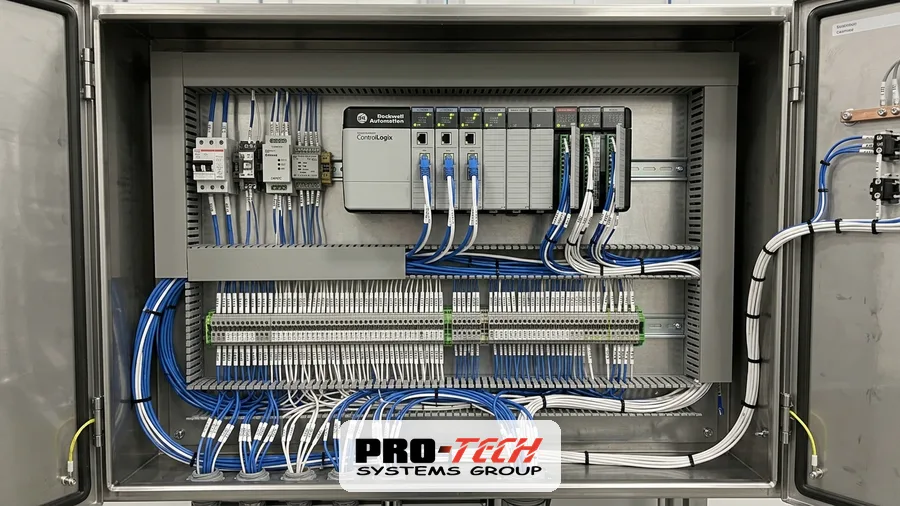
Modern engineering methodologies solve this challenge using pre-engineered wiring conversion systems, such as the Rockwell Automation Bulletin 1492 conversion hardware. The technician snaps the existing swing arms from the legacy SLC 500 or PLC-5 chassis directly onto conversion mounting plates. Pre-assembled, factory-tested cables bridge the legacy field terminations directly into modern ControlLogix or CompactLogix I/O modules. By eliminating manual field landing, 1492 systems slash physical cutover labor by up to 75% and eliminate wiring mistakes entirely.
3. Implement a Phased, Multi-Stage Migration Framework
Plants operating continuous 24/7 processes rarely have the luxury of an extended two-week outage to overhaul entire control architectures. The most effective PLC upgrades leverage a phased cutover framework:
- Phase 1 (Network & Communications): Install modern Ethernet/IP switches and control gateways while leaving existing legacy racks in place. Bridge modern networks to legacy DH+ or RIO channels.
- Phase 2 (Processor Modernization): Replace the legacy central processing unit (CPU) with a modern ControlLogix controller. The new processor controls existing legacy I/O racks over legacy remote networks without disrupting field wiring.
- Phase 3 (I/O Chassis Modernization): Upgrade remote I/O chassis to modern distributed blocks during routine planned maintenance windows.
- Phase 4 (HMI & Operator Interface Overhaul): Migrate aging panel-mounted screens to modern high-performance graphical interfaces running on modern industrial computers.
4. Execute Clean Code Translation and Tag Optimization
Migrating control software from legacy ladder logic to modern tag-based architectures requires experienced engineering oversight. While automated conversion utilities can translate basic instruction sets, they frequently produce bloated, unoptimized code with confusing generic tag naming.
Legacy PLC-5 and SLC platforms rely heavily on fixed memory addresses (such as N7:0, B3:0, or T4:0), whereas modern Logix controllers utilize meaningful descriptive tag names. Controls engineers at ProTech Systems Group Inc. review and refactor converted logic, organizing raw data into clean User-Defined Data Types (UDTs), Add-On Instructions (AOIs), and standardized routine structures. This ensures the finished logic is intuitive for plant electricians and maintenance technicians to troubleshoot.
5. Establish Dual-Network Redundancy and Gateway Bridging
During large-scale industrial PLC upgrades, new and legacy equipment must often operate in parallel for months. Installing smart communication gateways allows legacy controllers to exchange mission-critical interlock data with newly commissioned modern platforms. Implementing resilient network topologies, such as Device Level Ring (DLR), ensures that a single severed Ethernet cable will not halt production across the facility.
Reviewing our turnkey industrial control systems engineering standards demonstrates how redundant communications safeguard plant uptime during complex transition periods.
6. Pre-Commission Panels with Factory Acceptance Testing (FAT)
Jobsite commissioning should never be the first time new control programs and hardware communicate. Conducting a rigorous Factory Acceptance Test (FAT) inside a certified panel shop verifies operational logic before equipment ever arrives at your facility.
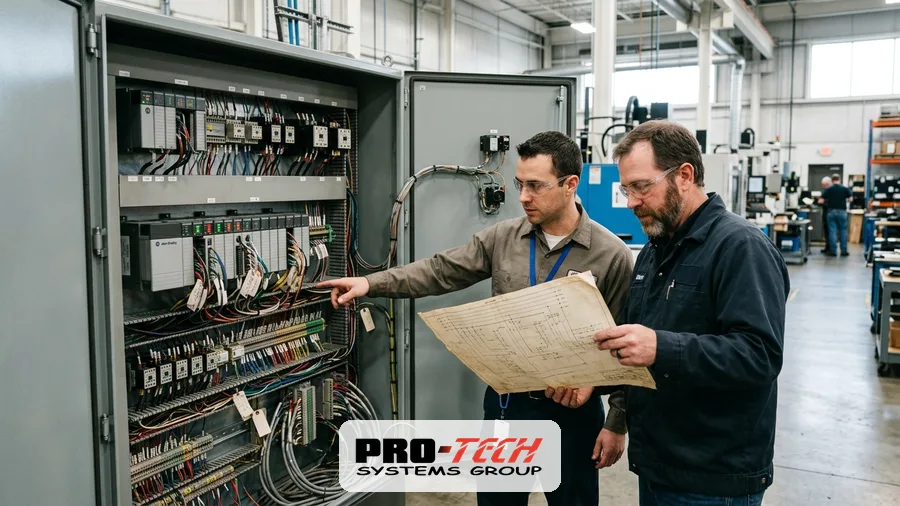
At our UL 508A certified control panel fabrication facility, ProTech Systems Group Inc. builds custom simulation racks to exercise all digital and analog loops. Engineers simulate pump run feedback, variable frequency drive (VFD) speed references, and emergency stop circuits against simulated process conditions. Catching logic bugs and scaling discrepancies in a controlled shop environment guarantees rapid, predictable cutovers on site.
7. Demand Full Code Ownership and Complete As-Built Documentation
The true measure of a successful automation project is how easily your internal maintenance team can service the system after the integrator leaves. Never accept proprietary, locked code blocks or password-protected routines that hold your facility hostage.
ProTech Systems Group Inc. maintains an uncompromising open-architecture philosophy. Upon project completion, we deliver fully annotated, unlocked source code, comprehensive CAD wiring schematics, network layout diagrams, and operator manuals. Your plant owns 100% of the intellectual property, ensuring long-term operational autonomy.
Comparing Legacy Control Platforms vs Modern Architecture
| Architecture Parameter | Legacy Systems (PLC-5 / SLC 500) | Modern Platforms (ControlLogix / CompactLogix) |
|---|---|---|
| Manufacturer Support Status | Discontinued / Obsolete (Silver Series) | Active Lifecycle with Regular Firmware Updates |
| Spare Parts Availability | Unreliable third-party surplus / auction brokers | Immediate authorized factory distribution stock |
| Networking Protocols | Proprietary serial (DH+, DH-485, RIO) | Open standard Ethernet/IP, CIP Safety, DLR |
| Memory & Tag Structure | Fixed memory tables (N7, B3, T4, C5) | Descriptive tag-based User Defined Types (UDTs) |
| Cybersecurity Compliance | Zero native security / plaintext communications | Encrypted protocols, digital signing, CIP Security |
| SCADA System Integration | Requires obsolete serial interface cards | Direct high-speed polling into modern SCADA architectures |
Why Partner with a Certified Rockwell Automation Silver Tier Integrator?
Selecting the right systems integrator is just as vital as selecting the hardware. As an officially recognized Rockwell Automation Silver Tier system integrator, ProTech Systems Group Inc. brings certified product expertise, dedicated factory support channels, and direct access to specialized migration engineering tools from Rockwell Automation’s lifecycle modernization programs.
Operating continuously since 1986 from Akron, Ohio, our multidisciplinary team of electrical engineers, panel fabricators, and field service technicians has successfully completed hundreds of complex migrations across municipal water plants, chemical processing operations, and heavy industrial facilities.
Frequently Asked Questions About Industrial PLC Upgrades
How much does a typical industrial PLC upgrade cost?
The cost of industrial PLC upgrades varies depending on I/O count, enclosure size, and cutover constraints. A straightforward standalone CompactLogix migration for a single machine typically ranges between $15,000 and $35,000. Larger multi-rack facility overhauls involving redundant ControlLogix processors, 1492 conversion kits, and SCADA updates generally range from $45,000 to $150,000 or more.
Can we upgrade our PLC processor without replacing existing field wiring?
Yes. Utilizing pre-engineered 1492 wiring conversion systems allows technicians to mount modern I/O hardware directly to existing field termination arms without disconnecting a single field conductor. This eliminates wiring errors and drastically reduces physical downtime.
How long does the physical cutover take during planned PLC upgrades?
With pre-tested 1492 conversion hardware and complete Factory Acceptance Testing, a physical cutover can frequently be completed within an 8-to-12-hour weekend shutdown window, allowing normal production to resume on Monday morning.