
Key Takeaways
- ISA-18.2 is the industry standard for SCADA and process alarm management, defining a 10-stage alarm lifecycle from philosophy through audit.
- A well-managed system targets roughly 150 or fewer alarms per operator per day and near-zero standing or nuisance alarms.
- Alarm rationalization — reviewing each alarm for a defined purpose, priority, and operator response — is the highest-impact step for cutting alarm floods.
- Pro-Tech Systems Group designs and remediates SCADA alarm systems to ISA-18.2 for water, wastewater, oil & gas, and manufacturing operations.
SCADA Alarm Management: 7 Essential Best Practices Under ISA-18.2
Effective SCADA alarm management is the difference between an operator who catches a process upset within the first minute and one who watches a cascading incident unfold on screen. In every post-incident review Pro-Tech Systems Group has participated in — water utilities, midstream gas, food and beverage, and discrete manufacturing — the same pattern appears: too many alarms, no prioritization, no rationalization, and no feedback loop to the engineering team that configured them in the first place.
This guide translates the ANSI/ISA-18.2 standard and the related IEC 62682 framework into a practical SCADA alarm management program that your operations team can implement in phases, without taking the plant down or requiring a forklift replacement of your existing SCADA system.
Why SCADA Alarm Management Matters
Every alarm is a request for operator action. When a console fires 600 alarms per hour, no operator can act on all of them — so they act on none of them. Alarm floods have been a root or contributing cause in several of the most widely studied process incidents, including the Texaco Milford Haven refinery explosion and the Buncefield oil terminal fire. Regulators now treat SCADA alarm management as a safety-critical discipline rather than an HMI configuration detail.
ANSI/ISA-18.2-2016 defines the alarm management lifecycle: philosophy, identification, rationalization, detailed design, implementation, operation, maintenance, monitoring, management of change, and audit. Done well, the lifecycle transforms alarms from background noise into the operator’s most trusted decision-support tool. Done poorly, it actively degrades plant safety — which is why the Occupational Safety and Health Administration and the U.S. Chemical Safety Board increasingly cite alarm performance metrics in their post-incident reports.
The 7 Essential Best Practices for SCADA Alarm Management
1. Write and Sign the Alarm Philosophy Document First
A successful SCADA alarm management program begins with a signed philosophy document — typically 30 to 50 pages — that defines what an alarm is and is not, who is authorized to create one, how priorities are assigned, and the performance targets the program must meet. Align the philosophy with ISA-18.2 clause 6 and the company safety case. Include operations, engineering, safety, and cybersecurity stakeholders in the approval chain. Without this document, every subsequent decision becomes an argument.
2. Rationalize Every Existing Alarm
Most brownfield SCADA alarm management projects inherit thousands of legacy alarms, many configured decades ago, that were never reviewed against a consistent standard. Rationalization is the disciplined, line-by-line review of every configured alarm to confirm that it represents a genuine abnormal condition requiring operator action. Document the consequence of inaction, the required operator response, the expected response time, and the priority class. Alarms that fail any of those criteria are either redesigned, delayed, or deleted. A typical rationalization reduces active alarm counts by 50-80%.
3. Enforce an ISA-18.2 Priority Distribution
ISA-18.2 recommends the following target distribution of configured alarms: approximately 80% low priority, 15% medium priority, and 5% high priority, with any urgent or emergency priority reserved for truly life-threatening conditions. Real-world legacy systems often invert this, with half of all configured alarms set to the highest priority because each engineer who added one wanted operator attention. Prioritize based on consequence severity multiplied by likelihood, documented in the rationalization register, and enforce the distribution through automated audits of the SCADA alarm management configuration.
4. Apply Advanced Alarm Techniques to Cut Noise
Out-of-the-box SCADA alarm management configuration typically fires on setpoint crossings with no filtering. A small amount of engineering eliminates most nuisance alarms:
- Deadbands and on-delays suppress chattering when a process variable hovers near a threshold
- State-based alarming disables alarms that are irrelevant in the current operating mode (startup, shutdown, cleaning, maintenance)
- First-out and parent-child suppression ensure that a single upstream condition generates one operator-actionable alarm rather than a cascade of downstream consequences
- Dynamic alarming tightens limits during steady-state operation and widens them during known transients, such as batch transitions
Engineered alarm suppression is fully supported by ISA-18.2, provided the logic is documented, tested, and reviewed through management of change. Do not confuse suppression with shelving; the two are separate controls with separate audit trails.
5. Invest in High-Performance HMI and Alarm Response Procedures
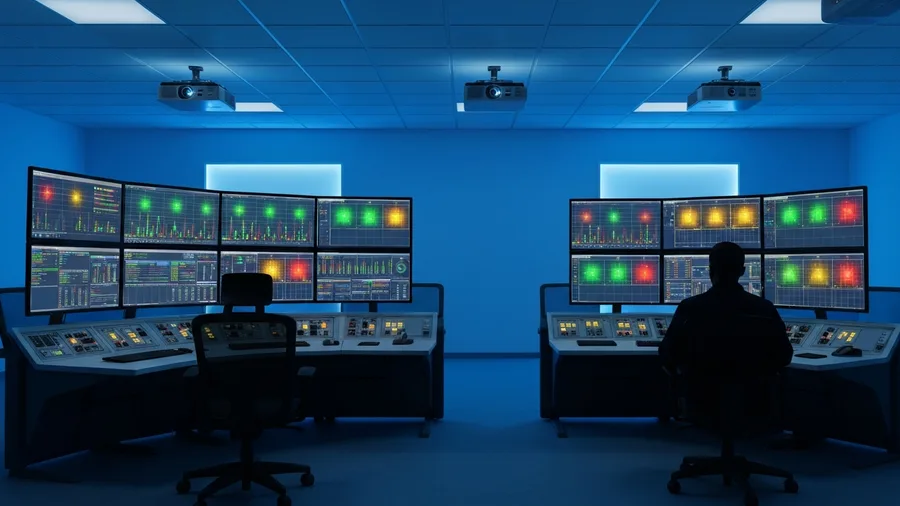
Operators cannot manage alarms if the HMI hides them. Apply ISA-101 High-Performance HMI principles across every console: greyscale baseline, saturated color reserved for active alarms only, alarm summaries that filter by priority and time, and rapid navigation from the alarm list to the responsible graphic. Pair every rationalized alarm with an alarm response procedure (ARP) that tells the operator what action to take, what to check first, and when to escalate. Modern SCADA alarm management tools embed the ARP directly in the alarm summary, so the guidance is one click away at 3 a.m.
6. Measure the Right Alarm KPIs Every Shift
SCADA alarm management performance is measurable. The metrics every operations leader should review weekly — and every plant manager should review monthly — come straight from ISA-18.2 Annex A:
- Average alarms per operator hour (target: under 6, acceptable: under 12)
- Peak alarm rate during the worst 10-minute window (target: under 10 per 10 minutes)
- Standing alarm count at the start of each shift (target: under 10)
- Top 10 most-frequent alarms (the “bad actor” list — these are always the first rationalization candidates)
- Priority distribution of configured alarms versus the ISA-18.2 target
- Percentage of alarms with a documented response procedure (target: 100% for priority 2 and above)
Most SCADA platforms expose these KPIs natively or via historian tags. If yours does not, a modest investment in an alarm analytics tool pays for itself the first time it finds the top ten bad actors responsible for half the console load.
7. Lock In Governance With Management of Change
A rationalized SCADA alarm management system decays within a year if no one protects it. Every new alarm, every setpoint change, and every priority upgrade must go through a management of change (MOC) process that includes sign-off from operations, engineering, and safety. Version-control the master alarm database in the same repository as PLC code and HMI graphics. Audit the live system against the master database quarterly and escalate any unreviewed additions. Without MOC enforcement, well-meaning engineers will silently add “just one more alarm” until the console returns to its pre-rationalization state.
Signs Your SCADA Alarm Management Program Needs Help
If any of these describe your facility, it is time to bring in support:
- Operators routinely acknowledge alarms without reading them
- The standing alarm count exceeds 100 at any point during a normal shift
- No written alarm philosophy exists, or the existing one is over five years old
- Alarm priorities are distributed roughly evenly across high, medium, and low (no ISA-18.2 shape)
- More than 20% of active alarms have no documented response procedure
- Chattering alarms fire more than 60 times per hour during normal operations
- Regulatory auditors have cited alarm-related findings in the last audit cycle
How Pro-Tech Delivers a Full SCADA Alarm Management Program
Pro-Tech Systems Group is a Rockwell Automation Silver Tier System Integrator with nearly 40 years of process automation experience across water and wastewater, oil and gas, manufacturing, and energy sectors. Our SCADA alarm management services include philosophy development, facilitated rationalization workshops, implementation of advanced alarming logic (deadbands, state-based suppression, dynamic limits), SCADA platform tuning, operator training, and ongoing monitoring against ISA-18.2 KPIs.
We have helped operators cut alarm rates by more than 70%, close out regulatory findings, and — most importantly — give their operators a console they can trust during the worst ten minutes of the year. For operators concerned about cybersecurity interactions in alarm handling, see our related analysis of SCADA attacks and lessons learned, as well as our top SCADA security best practices guide.
Next Steps
If your operators are drowning in alarms, your next audit is on the calendar, or your facility is about to expand, and you want to avoid repeating legacy mistakes, contact Pro-Tech Systems Group for a free baseline assessment of your alarm system. We will pull one week of alarm history, compare against ISA-18.2 targets, and deliver a concrete remediation roadmap. Call (330) 773-9828 or fill out the contact form on our website.
Frequently Asked Questions
What is SCADA alarm management?
SCADA alarm management is the disciplined practice of defining, rationalizing, implementing, monitoring, and maintaining the alarms presented to operators through a SCADA HMI. It follows the ANSI/ISA-18.2 and IEC 62682 lifecycle and is designed to ensure every alarm represents a genuine abnormal condition that requires operator action within a defined response time.
How many alarms per hour is too many?
ISA-18.2 targets an average of fewer than 6 alarms per operator hour in steady-state operation, with fewer than 12 considered manageable and anything above 30 considered an alarm flood. Peak rates during upsets should remain below 10 alarms per 10-minute window.
Do I need to replace my SCADA system to fix alarm management?
No. The vast majority of SCADA alarm management improvements come from configuration, not platform replacement. A structured rationalization program and advanced alarm techniques (deadbands, state-based suppression, first-out logic) can be implemented on virtually any modern SCADA platform without a forklift upgrade.
SCADA Alarm Management (ISA-18.2): FAQs
What is ISA-18.2 alarm management?
ISA-18.2 is the ANSI/ISA standard for the management of alarm systems in the process industries. It defines an alarm as an audible or visual signal indicating a condition that requires a timely operator response, and it lays out a full lifecycle for designing, operating, and maintaining those alarms so operators are not overwhelmed.
What are the stages of the ISA-18.2 alarm lifecycle?
The lifecycle covers alarm philosophy, identification, rationalization, detailed design, implementation, operation, maintenance, monitoring and assessment, management of change, and audit. Each stage feeds the next, and monitoring plus management of change keep the system healthy over time.
What is an acceptable alarm rate per operator?
ISA-18.2 guidance considers roughly 150 alarms per operator per day (about one every ten minutes) to be manageable, with fewer being better. Rates well above this, or frequent alarm floods during upsets, indicate the system needs rationalization.
How do you reduce nuisance alarms in a SCADA system?
The most effective step is alarm rationalization: reviewing every configured alarm to confirm it has a clear cause, a defined operator response, an appropriate priority, and correct setpoints and deadbands. Removing duplicate, chattering, and standing alarms typically cuts the alarm load dramatically.
Why is alarm management important for SCADA?
Poorly managed alarms cause operator overload, missed critical events, and slower response during upsets — a factor in several major industrial incidents. A rationalized, ISA-18.2-compliant system keeps genuine problems visible and actionable, improving both safety and uptime.