What to Look for in Oil and Gas Automation Companies in 2026
The energy industry is undergoing a rapid digital transformation, and oil and gas automation companies are at the center of it. From wellhead monitoring to pipeline SCADA to tank farm inventory management, the right automation partner can reduce operating costs by 15-30% while simultaneously improving safety outcomes and regulatory compliance across your entire operation.
But not all oil and gas automation companies are created equal. Some specialize in upstream production, others focus on pipeline monitoring, and many lack the breadth of experience to handle complex, multi-site deployments. This guide helps operators, production managers, and engineering teams evaluate potential partners based on the criteria that actually matter when equipment is running 24/7 in harsh field conditions.
Why Oil and Gas Automation Is No Longer Optional
Three converging pressures are accelerating automation adoption across the oil and gas sector:
- Workforce shortage: The oil and gas industry faces a growing skilled labor gap as experienced operators retire and fewer young workers enter the field. A 2025 Deloitte study found that 50% of the oil and gas workforce will be eligible for retirement within 10 years. Automation reduces dependence on 24/7 manual monitoring by enabling remote operations and centralized control of distributed assets.
- ESG and regulatory compliance: Environmental, Social, and Governance reporting requirements continue to expand. Methane emission monitoring, leak detection and repair (LDAR) programs, produced water tracking, and spill prevention all increasingly require real-time automated data collection with audit-ready reporting capabilities.
- Production optimization: Marginal wells, mature fields, and stripper wells demand precise control to remain economically viable in volatile commodity markets. Digital oilfield automation uses real-time data analytics to optimize artificial lift settings, chemical injection rates, and well cycling schedules—extracting maximum production value from every asset in your portfolio.
6 Capabilities That Define the Best Oil and Gas Automation Companies
1. SCADA and Telemetry Expertise
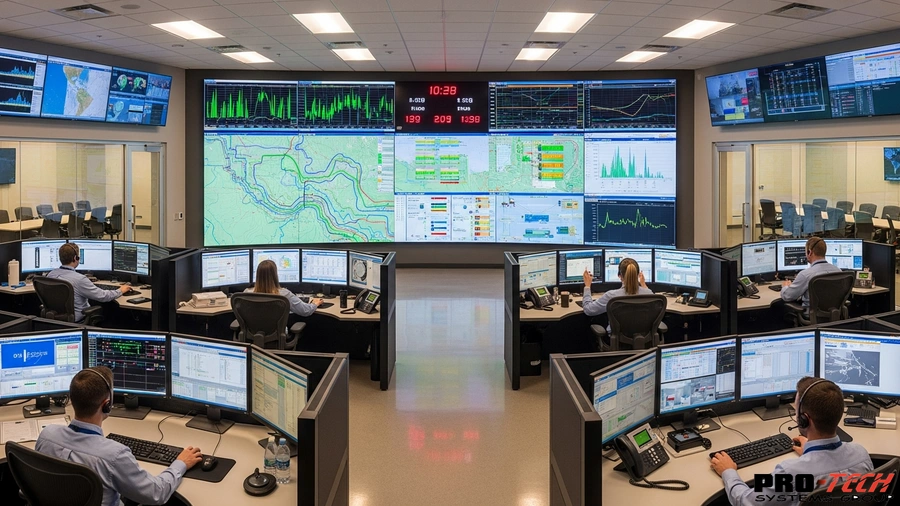
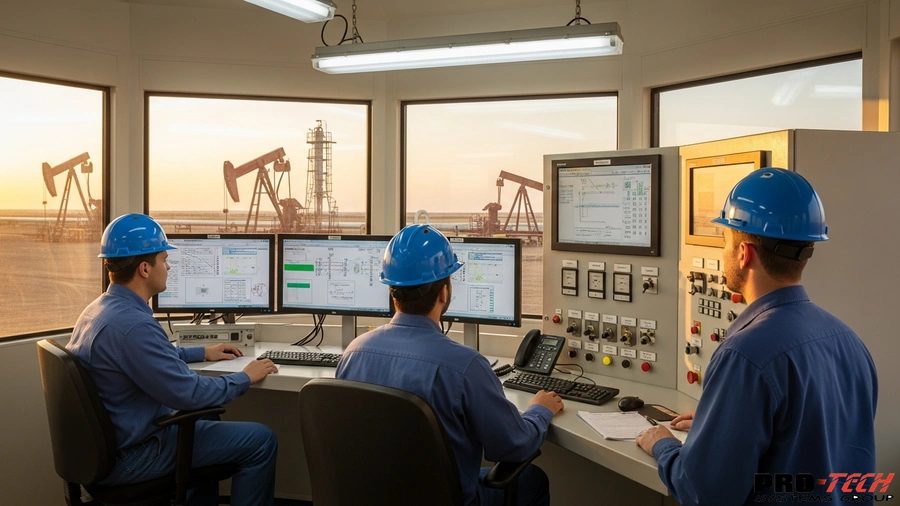
Oil and gas operations are inherently distributed across wide geographic areas—often spanning hundreds of square miles with limited infrastructure. The best oil and gas automation companies build robust SCADA systems with reliable telemetry networks—cellular, licensed radio, unlicensed spread-spectrum, satellite (VSAT/Iridium), or fiber—that deliver real-time production data, alarm notifications, and remote control capability from every well pad, compressor station, pipeline segment, and storage facility to a centralized control room.
2. Upstream, Midstream, and Downstream Coverage
Each segment of the oil and gas value chain has distinct automation requirements. Upstream automation focuses on well monitoring, artificial lift optimization (rod pump, ESP, gas lift), produced water handling, and wellhead safety systems. Midstream automation involves pipeline SCADA, compressor station control, gas processing, and custody transfer metering with API-compliant calculations. Downstream and storage automation requires tank gauging, product blending control, truck loading, and distribution management. The best oil and gas automation companies demonstrate proven capability across all three segments.
3. Remote Monitoring and Unmanned Operations
Many oil and gas facilities—particularly stripper wells, remote tank batteries, and unmanned compressor stations—operate in locations where full-time staffing is neither practical nor economical. Oil and gas automation companies must deliver solutions that enable fully unmanned operations with remote monitoring—including intelligent alarm management, automated emergency shutdown sequences, and secure mobile operator access for field personnel.
4. Cybersecurity for Critical Infrastructure
Oil and gas pipelines and production facilities are classified as critical infrastructure under federal law. Following the Colonial Pipeline ransomware attack, the Transportation Security Administration (TSA) issued mandatory cybersecurity directives for pipeline operators. The best oil and gas automation companies implement cybersecurity by design: IT/OT network segmentation, encrypted SCADA communications, role-based access control, continuous network monitoring, and documented compliance with TSA Pipeline Security Directives and NIST Cybersecurity Framework guidelines.
5. Integration with Existing Infrastructure
Most oil and gas operators are not building greenfield facilities from scratch. They need oil and gas automation companies that can integrate modern SCADA platforms with legacy RTUs (Fisher ROC, ABB TotalFlow, Emerson), aging PLCs, decades-old flow computers, and third-party instrumentation—all without disrupting active production. Brownfield integration expertise is far more valuable than greenfield design capability in today’s market.
6. 24/7 Field Support with Rapid Response
Production never stops, and neither should your automation support. A pipeline leak alarm at 3 AM or a compressor station communications failure during a winter storm requires immediate response. Evaluate whether your oil and gas automation companies maintain dedicated field service teams with 24/7 availability, regional spare parts depots, documented response time commitments, and the ability to provide remote diagnostic support while a technician is en route.
Questions to Ask Before Signing a Contract
When evaluating oil and gas automation companies for your next project, these seven questions will help you separate qualified partners from those who may underdeliver:
- How many oil and gas SCADA projects have you completed in the past 5 years, and can you provide operator references in my basin or production area?
- What telemetry platforms and communication technologies do you support for remote sites?
- How do you ensure compliance with TSA Pipeline Security Directives and NIST CSF?
- What is your guaranteed emergency response time for field service calls in my operating area?
- Do you provide comprehensive operator training as a standard part of your project scope?
- How does your proposed architecture handle the addition of new wells, compressor stations, or pipeline segments?
- What is your approach to integrating with our existing RTUs, flow computers, and legacy instrumentation?
Pro-Tech: A Trusted Name Among Oil and Gas Automation Companies
Pro-Tech Systems Group has provided automation solutions for oil and gas operations since 1986. As a Rockwell Automation Silver Tier System Integrator, we deliver SCADA, telemetry, control system integration, instrumentation and calibration, and 24/7 field service support across the full upstream-midstream-downstream value chain from our Akron, Ohio headquarters.
Ready to evaluate your automation options? Contact Pro-Tech Systems Group for a project consultation. Call (330) 773-9828 or complete our online inquiry form.