A Practical Guide to Water Treatment SCADA Security for Facilities (2026)
A Practical Guide to Water Treatment SCADA Security for Facilities
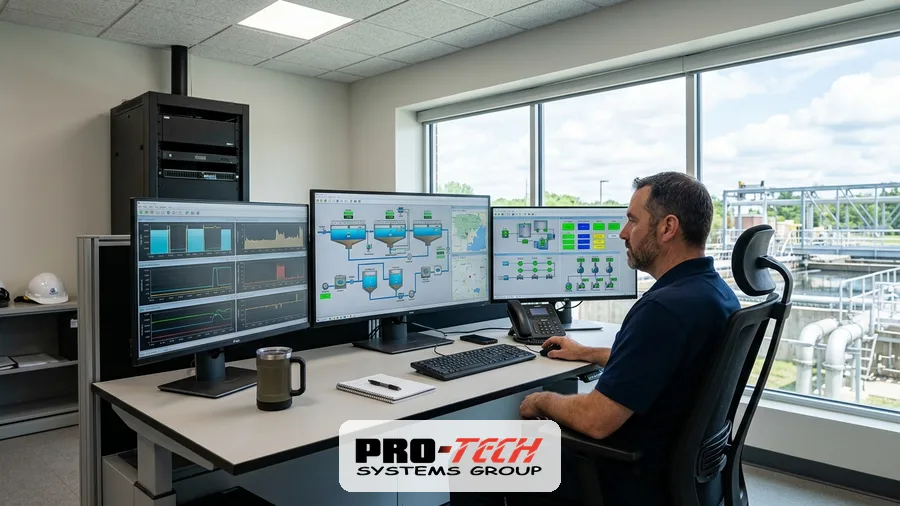
Water treatment facilities are the silent guardians of public health. Day in and day out, they ensure our communities have access to safe, clean water. At the heart of these critical operations lies the SCADA (Supervisory Control and Data Acquisition) system—the nerve center that monitors and manages everything from chemical dosing to distribution pressure. But as these systems become more interconnected, they also become more vulnerable. Securing this critical infrastructure is no longer an IT issue; it’s a public safety imperative.
The Real-World Risks of Inadequate SCADA Cybersecurity
For years, the operational technology (OT) that runs industrial facilities was isolated, or “air-gapped,” from the outside world. This is no longer the case. The push for efficiency and remote access has connected these vital industrial control systems to corporate networks and the internet, opening a doorway for cyber threats.
The consequences of a security breach in a water treatment facility are severe:
Public Health Crises: Attackers could alter chemical treatment processes, leading to the distribution of contaminated water.
Environmental Damage: A breach could cause manipulated valves or pumps to release untreated wastewater into the environment.
Operational Disruption: An attack can shut down operations, halting water supply to homes, hospitals, and firefighters.
Regulatory Fines and Reputational Damage: A successful attack can lead to costly fines and a complete loss of public trust.
Understanding these stakes is the first step toward building a resilient SCADA cybersecurity posture.
The Top 5 SCADA Vulnerabilities Lurking in Water Treatment Plants
Here are the five most common weaknesses found in water treatment facilities today.
1. Unsecured Network Architecture: The most common vulnerability is a flat network where the SCADA system shares the same network as business computers, printers, and phones. A single phishing email that compromises a front-office PC could give an attacker a direct path to the control system. Lack of firewalls and direct internet connections for remote access create easily exploitable entry points.
2. Legacy Industrial Control Systems: Many facilities rely on PLCs, RTUs, and HMIs that are decades old. This equipment was engineered for reliability, not security. It often lacks modern security features like encryption and robust authentication, and may even run on unsupported operating systems like Windows XP, which no longer receive security patches.
3. Weak Access Control and Default Passwords: It’s alarmingly common to find water treatment SCADA components still using the factory-default passwords. Furthermore, many facilities lack granular, role-based access control. This means an operator might have the same administrative privileges as an engineer, violating the principle of least privilege and making it easier for an attacker with stolen credentials to cause maximum damage.
4. Insufficient Monitoring and Logging: If you aren’t actively monitoring your network traffic, you can’t detect a threat until it’s too late. Many water facilities lack the tools—like an Intrusion Detection System (IDS) or a Security Information and Event Management (SIEM) system—to identify anomalous activity, such as an unauthorized user accessing a critical pump controller at 3 a.m.
5. The Human Element: The most sophisticated security technology can be undone by a single human error. A lack of ongoing cybersecurity training for employees leads to weak password habits, susceptibility to phishing attacks, and improper use of removable media like USB drives, which can introduce malware directly into the control environment.

Actionable Water Treatment SCADA Security Best Practices for Water Automation
Knowing the vulnerabilities is only half the battle. Implementing a defense-in-depth strategy for water treatment SCADA security is the key to securing critical infrastructure. Here are the essential best practices to implement.
1. Conduct a Comprehensive Risk Assessment: You cannot protect what you do not know you have. The first step is a thorough audit of your entire water treatment automation environment. This involves creating an inventory of all connected assets, identifying communication pathways, and pinpointing specific vulnerabilities in your hardware, software, and network architecture.
2. Implement Robust Network Segmentation: This is arguably the most effective security measure you can take. Isolate your water treatment SCADA network from your corporate business network using firewalls. Create zones and conduits based on the Purdue Model to restrict communication. A properly segmented network ensures that a compromise on the business side cannot easily pivot to the critical control systems.
3. Enforce Strict Access Control:
Password Policies: Eliminate all default passwords and enforce strong, complex password requirements with regular rotation.
Role-Based Access: Ensure users only have access to the systems and functions essential for their jobs.
Multi-Factor Authentication (MFA): Implement MFA for all remote access connections to provide a critical layer of verification.
4. Deploy Continuous Monitoring and Threat Detection: Implement an IDS specifically designed for industrial control systems. These tools understand OT protocols (like Modbus and DNP3) and can alert you to suspicious activity in real-time. Centralized logging and regular review are essential for forensic analysis after an event.
5. Develop and Practice an Incident Response Plan: When an incident occurs, panic is not a strategy. A formal Incident Response Plan outlines the exact steps to take, from initial detection and containment to eradication and recovery. This plan should be practiced through tabletop exercises to ensure every team member knows their role.
Partnering for a Secure Future
Securing a water treatment SCADA system is not a one-time project; it is an ongoing process of assessment, implementation, and vigilance. The threat landscape is constantly evolving, and the technology used to defend against it must evolve as well.
Don’t leave your community’s safety to chance. Partnering with a specialist in industrial control systems and cybersecurity is the most effective way to protect your facility. An experienced integrator can help you navigate the complexities of risk assessment, network design, and implementing security controls that work for your unique operational environment.
Is your critical infrastructure secure? Contact Pro-Tech Systems Group (PTSG) today for a comprehensive assessment of your water treatment SCADA security and take the first step toward a more resilient future.
Related posts