Key Takeaways
- Municipal bulk water fill stations lose revenue to coin theft, jammed mechanisms, unmetered draws, and unrecorded manual sales.
- A cashless, metered station recovers that revenue by requiring a card or RFID credential and logging every gallon dispensed.
- Pro-Tech Systems Group tracks all usage and reconciles it for the owner, providing scheduled payouts monthly, quarterly, or annually.
- Legal-for-trade metering and SCADA integration give administrators accurate, auditable revenue data.
Most of the revenue lost at a municipal bulk water fill station never shows up as theft. It disappears quietly, a few gallons at a time, through a drifting meter, a jammed coin box, a fill that no one logged, or a price that has not been updated since the last rate increase. None of it triggers an alarm. It just means the cash that comes in each month is a little lower than the water that went out, and over a year that gap adds up to real money the utility could have collected.
This is an operator’s guide to closing that gap. It is written for the people who actually run the station: operators, administrators, and maintenance crews. If you are still deciding what to buy, start with the bulk water fill stations buyer’s guide. If you already own a unit and want to stop the leaks, keep reading.
Where a municipal bulk water fill station leaks revenue
Before you can recover revenue, you have to know where it goes. On a typical station, the losses cluster in five places:
- Cash handling. Coins jam, get miscounted, or get skimmed between the box and the bank.
- Meter drift. A mechanical meter that reads low under-bills every fill, and it gets worse over time.
- Unlogged fills. Manual overrides and “just this once” fills that never make it into the record.
- Stale pricing. A rate that was set three budget cycles ago and never pushed to the panel.
- Downtime. Every hour the station is out of service is water no one can buy from you.
The American Water Works Association treats this category as non-revenue water, and its water loss control resources are a useful framework for putting a dollar figure on each leak before you fix it.
1. Replace cash handling with cashless payments
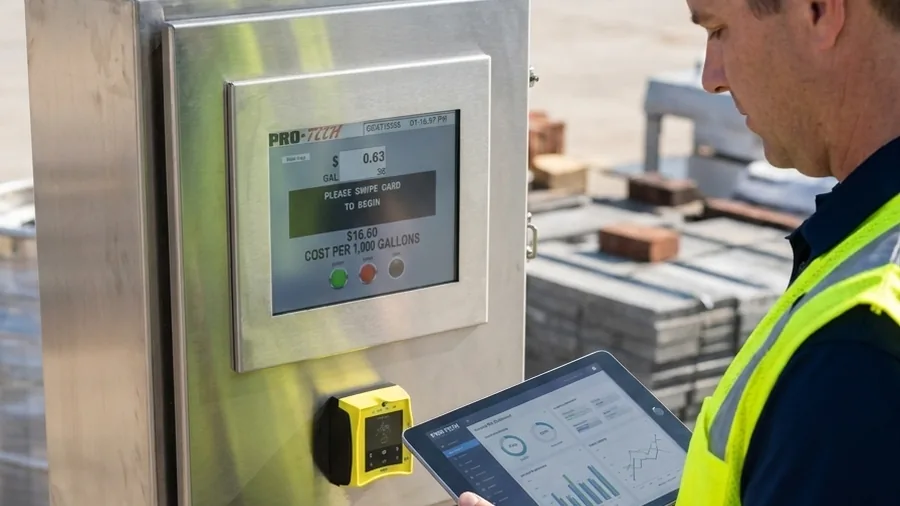
Cash is the largest and least trackable leak on most stations. Coins jam the mechanism, pickups get skipped, and a bag of coins is impossible to audit against a meter reading. Moving to card and RFID payment removes the cash path entirely and ties every fill to an electronic record.
This is usually the single biggest recovery on an older unit, which is why it gets its own deep dive. See cashless versus coin-op stations for the full comparison and the EMV and RFID details.
2. Put every fill on an auditable ledger
A coin box gives you a number you cannot check. A networked municipal bulk water fill station gives you a line for every transaction: who filled, how many gallons, at what price, on what date and time. When the bank deposit and the transaction ledger agree to the penny, you have found and closed your reporting leak.
On a Pro-Tech station, every transaction routes through PTSG’s managed billing service, and the utility pulls the raw data on demand. The reconciliation that used to take an afternoon with a coin counter becomes a report you can run from a desk.
3. Get your pricing current and keep it current
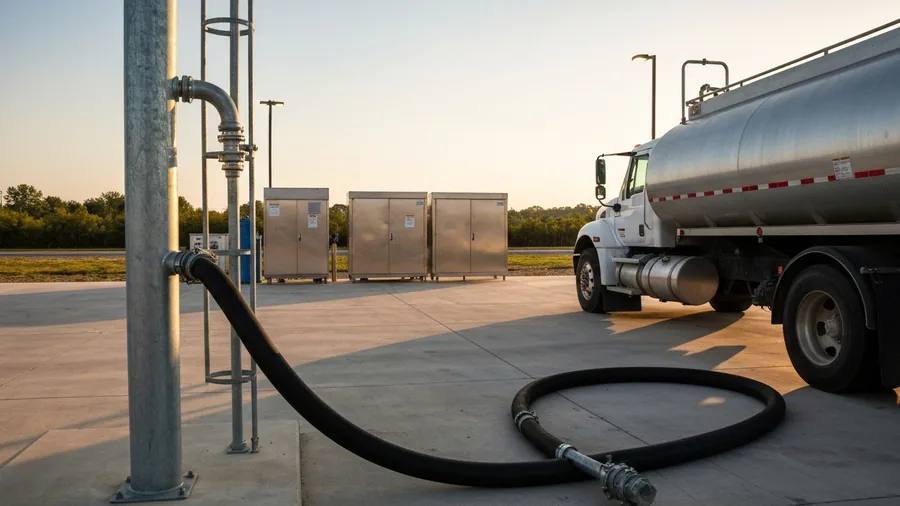
Stale pricing is the leak operators forget. If your rate per thousand gallons has gone up but the panel still charges the old number, you are subsidizing every hauler who fills there. With a remote-managed station, the operator pushes a new price from a browser the day the rate changes, with no truck roll and no re-pinning of a mechanism. Set a reminder tied to your rate ordinance so the panel price and the billed rate never drift apart again.
4. Use RFID accounts to capture your regular haulers
One-off card payments are fine for the occasional user, but your volume comes from repeat haulers: contractors, neighboring districts, and municipal crews. Put each of them on an RFID account. They tap a fob, the fill bills to a monthly statement, and you stop losing the small transactions that are not worth the friction of a card swipe. Account billing also gives you a clean record to chase if a statement goes unpaid, which a coin box never could.
5. Tie the station into SCADA so problems surface fast
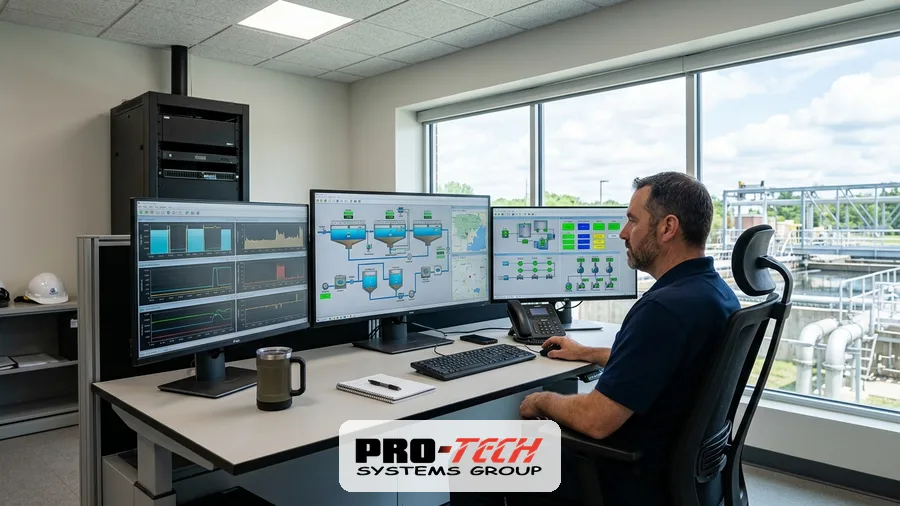
You cannot sell water from a station that is down, and the longer a fault goes unnoticed, the more revenue you lose. Bringing the unit into your existing control system fixes that. Pro-Tech stations expose flow, pressure, and operational status over Modbus TCP, EtherNet/IP, or OPC UA, so the municipal bulk water fill station appears on the same HMI as the rest of your distribution system. A fault raises an alarm the crew already watches instead of waiting for a hauler to call and complain.
For the technical integration details, see the bulk water station service page.
6. Calibrate and verify the meter on a schedule
A cashless system only recovers revenue if the meter behind it is honest. A flow meter that drifts low quietly under-bills every transaction, and unlike a coin jam it never announces itself. Build a calibration check into your maintenance schedule, and verify the meter reading against a known fill volume at least annually. Pair the meter data with the transaction ledger and any discrepancy shows up immediately rather than hiding in the monthly total. The EPA treats meter accuracy as a core part of controlling water loss, and its guidance on water audits and water loss control is a good reference for setting a verification interval that holds up to an audit.
7. Cut downtime with remote diagnostics
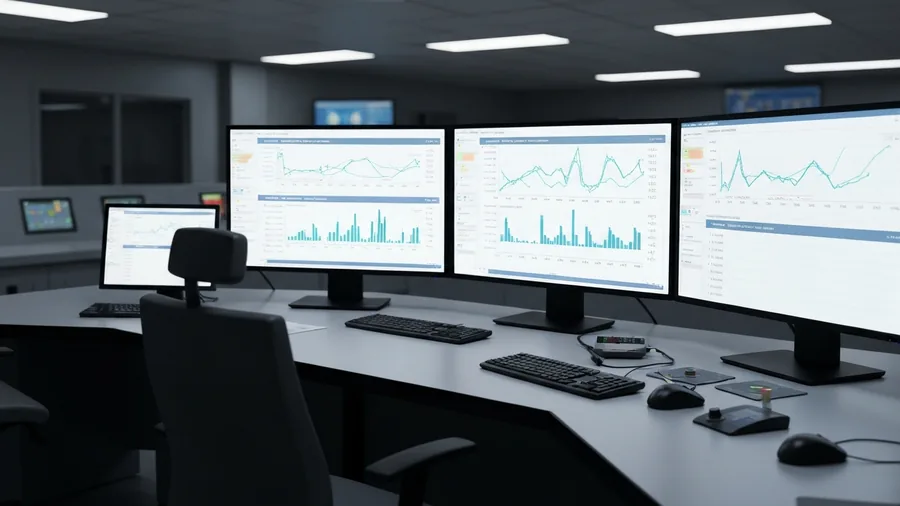
Every hour offline is lost sales. Remote diagnostics let the operator see an out-of-service flag, a payment hardware fault, or a connectivity drop the moment it happens, and often resolve it without a site visit. When a truck roll is genuinely needed, the crew arrives knowing the fault instead of diagnosing it on site. Faster recovery means more hours the station is actually selling water.
8. Reinvest with American-made eligibility intact
When the recovered revenue justifies an upgrade or a second site, protect your funding options. Many municipal water projects draw on federal money, the EPA’s Clean Water and Drinking Water State Revolving Fund loans or ARPA water allocations, and those programs carry Build America, Buy America requirements. Pro-Tech stations are built in Akron, Ohio, and ship with BABA compliance documentation on request, so the reinvestment stays eligible. You can confirm the funding rules through the EPA’s State Revolving Fund program pages.
A simple recovery checklist
Run through this list against your current station:
| Leak | Quick test | Fix |
|---|---|---|
| Cash handling | Does the deposit match the meter? | Go cashless (card + RFID) |
| Meter drift | Verified against a known fill volume? | Annual calibration check |
| Unlogged fills | Any manual overrides this month? | Lock to account-only billing |
| Stale pricing | Panel price = current ordinance rate? | Remote price update |
| Downtime | Hours offline last quarter? | SCADA alarms + remote diagnostics |
Frequently asked questions
How much revenue can a municipal bulk water fill station actually recover?
It depends on your current losses, not on volume alone. Utilities replacing coin-only units commonly recover a few percent of gross bulk-water revenue in the first year, most of it from eliminated cash handling and reduced downtime. The honest way to size it is to audit your own deposits against your meter for a few months and see where the gap is.
Do we need to replace the whole station to stop the leaks?
Often no. If the site has utility power, a network connection, and a flow meter with a usable output, you can add cashless payment, remote management, and SCADA reporting as a retrofit rather than a full rebuild. A retrofit is faster and lower cost than a new install.
Who installs the equipment?
Installation is handled by the municipality’s own licensed electrician and plumber. Pro-Tech supplies the panel, control valve, flow meter, and startup service, which keeps install costs in your control and avoids waiting on an outside crew.
Will the reporting satisfy our finance department and auditors?
Yes. Every transaction is logged with user, gallons, price, and timestamp, and payouts come on a monthly, quarterly, or annual schedule with line-item detail. The utility owns the raw data and can produce it for an audit on demand.
Will it work with the SCADA system we already run?
Yes. The station communicates over Modbus TCP, EtherNet/IP, or OPC UA and appears as another endpoint in your existing HMI, so faults and flow data show up where your crew already looks.
Start with one audit
You do not need new equipment to start recovering revenue. Start with one audit: pull three months of deposits, compare them to the meter, and see where the gap is. In most cases the answer points straight at cash handling, stale pricing, or downtime, and each of those has a fix above.
When you are ready to act on it, Pro-Tech Systems Group builds and services bulk water fill stations across the eastern US from Akron, Ohio. Call (330) 773-9828 or reach us through the bulk water station page to set up a site review.
Recovering Lost Bulk Water Revenue: FAQs
How do municipalities lose revenue at bulk water fill stations?
The most common losses come from coin theft and vandalism, jammed or bypassed coin mechanisms, unmetered or manually recorded draws, and water taken without payment. Older coin-op and open-standpipe setups have no reliable record of who took how much.
How does a cashless station recover that lost revenue?
A cashless station requires a valid card or RFID credential before dispensing and meters every gallon, so all water is paid for and recorded. This closes the gaps that coin-op and open systems leave open, turning untracked losses into accounted revenue.
How is bulk water usage tracked and accounted for?
Pro-Tech Systems Group tracks every transaction through the control panel and reconciles usage for the station owner. Administrators get accurate records tied to legal-for-trade metering, and the system can feed data into the municipality’s existing SCADA.
How are payouts to the municipality handled?
Pro-Tech Systems Group manages the accounting and provides the station owner with payouts on a monthly, quarterly, or annual basis, depending on the arrangement, so the revenue flows back to the city or utility on a predictable schedule.