SCADA vs IIoT: Why You Need Both for Digital Transformation Success
SCADA vs IIoT: Why You Need Both for Digital Transformation Success
In the race toward Industry 4.0, facility managers and engineers are often bombarded with buzzwords. Two of the most prominent acronyms—and often the most confused—are SCADA (Supervisory Control and Data Acquisition) and IIoT (Industrial Internet of Things). The debate of SCADA vs IIoT is a common topic in boardrooms, but it is frequently framed incorrectly.
A dangerous misconception in the industrial sector is that this is an “either/or” decision. Many assume that the Industrial Internet of Things is simply a newer, shinier replacement for traditional SCADA. This faulty assumption can stall your digital transformation efforts before they begin.
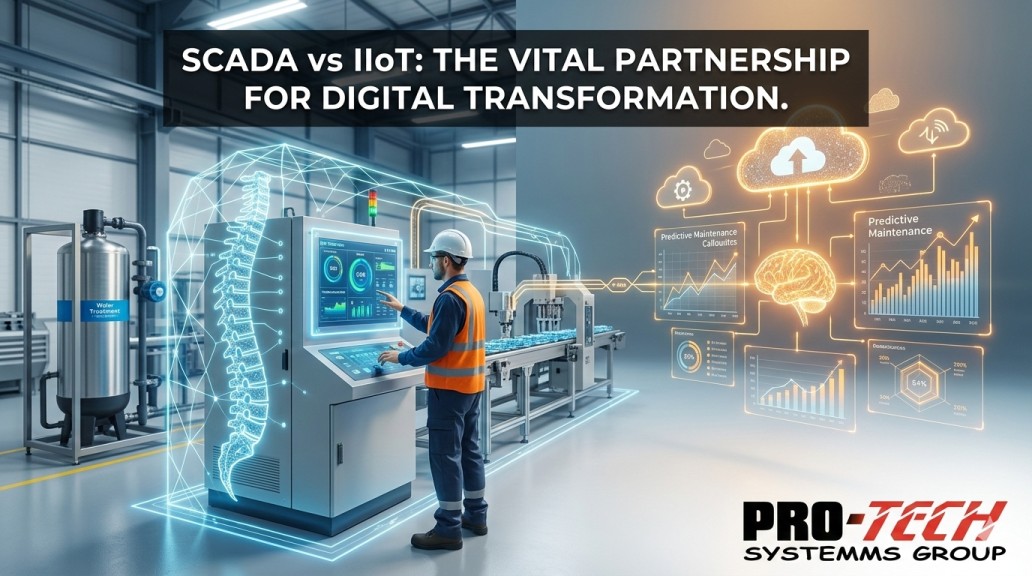
The truth is, SCADA vs IIoT is not a competition; it is a partnership. One is the reliable heartbeat of your daily operations; the other is the strategic brain that analyzes long-term health. To achieve a truly smart factory, you don’t choose between them—you integrate them. Here is a comprehensive breakdown of the landscape and why successful manufacturers are leveraging both.
Table of Contents
The Reliable Backbone: Understanding SCADA Systems
To understand the future, you must appreciate the foundation. For decades, SCADA Systems have been the central nervous system of industrial facilities, from water treatment plants to manufacturing floors.
A SCADA system is designed for one critical purpose: real-time operational control. It connects directly to sensors, valves, pumps, and motors via PLCs (Programmable Logic Controllers) and RTUs (Remote Terminal Units). When an operator looks at an HMI screen on the plant floor, they are seeing exactly what is happening right now.
The Core Strengths of SCADA
- Real-Time Control: Low latency response for mission-critical operations. If a tank pressure exceeds a safety threshold, the SCADA software triggers an immediate alarm or automatically shuts down a pump to prevent disaster.
- Reliability & Security: Often operates on isolated, local networks (OT networks) designed for high availability, strictly separated from the internet.
- Operator Focus: Provides immediate visualization for floor staff via high-performance graphics.
If your goal is to ensure a machine turns off the millisecond a fault is detected, SCADA is irreplaceable. You can learn more about modernizing these systems on our Control Systems page.

The Strategic Brain: Understanding IIoT Solutions
If SCADA is about what is happening now, the Industrial Internet of Things is about what will happen next, and why. In the SCADA vs IIoT equation, IIoT represents the analytical layer.
IIoT Solutions are composed of interconnected smart devices, advanced sensors, and inexpensive connectivity that gather vast amounts of data across the entire enterprise. Unlike the localized nature of SCADA, an IIoT platform is designed to push this data to the cloud or edge servers for heavy-duty computational analysis.
IIoT doesn’t just tell you a motor is vibrating; it compares that vibration pattern against historical data and thousands of other motors to predict when it will fail.
The Core Strengths of IIoT
- Big Data Analytics: Capable of processing massive datasets (Tera-bytes) that would choke traditional SCADA software.
- Predictive Capabilities: Enables predictive maintenance and machine learning models to foresee issues before they cause downtime.
- Scalability & Interoperability: Easily connects disparate systems across multiple plant locations using standard internet protocols (like MQTT).
SCADA vs IIoT: 3 Critical Differences
While they handle similar data, their approach and purpose differ significantly. To plan your architecture, you must understand these three distinctions.
1. Data Scope and Frequency
SCADA focuses on high-frequency, real-time data needed for immediate control loops. It often discards granular data once it’s no longer operationally relevant. IIoT solutions focus on aggregated, granular data stored over long periods. It values historical context to identify trends that span months or years.
2. Connectivity and Location
SCADA is typically LAN-based and sits deep within the Operational Technology (OT) network, often air-gapped for security. IIoT bridges the OT network with the Information Technology (IT) network and the cloud, enabling secure remote access and advanced analytics from anywhere in the world.
3. Primary Action
SCADA is reactive and controlling. It acts now to maintain process stability. IIoT is analytical and prescriptive. It suggests actions for future optimization.

The Power of Integration: A Real-World Use Case
The debate shouldn’t be SCADA vs IIoT; it should be about SCADA plus IIoT. Trying to replace a robust SCADA system with pure IIoT for real-time process control is dangerous due to internet latency issues. Conversely, trying to perform complex machine learning analytics using only on-premise SCADA software is inefficient and expensive.
Scenario: The Overheating Pump
Imagine a critical pump in a process automation line. Here is how the two systems work together:
- The SCADA Role: The pump begins to overheat rapidly. The SCADA system detects that the temperature has crossed the safety threshold and instantly cuts power to the motor to prevent a fire. Result: Safety ensured.
- The IIoT Role: The IIoT platform analyzes the vibration and power consumption data from the weeks leading up to the failure. It determines that the root cause was a gradual bearing lubricant failure that started 10 days ago. It then automatically generates a work order for maintenance to check all similar pumps. Result: Future downtime prevented.
Frequently Asked Questions
No. While the lines are blurring, they serve different fundamental needs. IIoT will not replace the need for the low-latency, mission-critical control loops that SCADA provides on the plant floor. Instead, IIoT will continue to augment SCADA, taking over the roles of data analytics and reporting.
Yes, it is possible, especially in "greenfield" applications or by bypassing legacy controls with new overlay sensors. However, for most established facilities, the richest source of operational data already resides within their existing SCADA infrastructure, making integration the most logical path.
Avoid "closed garden" ecosystems. The best modern software supports open standards like OPC UA and MQTT. According to MQTT.org, this lightweight messaging protocol is becoming the standard for connecting IoT devices. Look for platforms that offer robust SQL database integration and web-based HMI capabilities.
Move Beyond the Buzzwords
Don’t let confusion over terminology slow down your modernization efforts. A successful strategy requires the stability of SCADA paired with the intelligence of IIoT. Whether you are dealing with legacy equipment or planning a new facility, the integration of these two technologies is the key to Industry 4.0.
If you are looking to upgrade your existing control systems or define a roadmap for practical digital transformation, we can help you navigate the integration process.
Ready to bridge the gap between your OT and IT? Contact Pro-Tech today for a comprehensive site audit and consultation.
Related posts