Top 5 PLCs for Industrial Automation in 2026: The Ultimate Guide
Top 5 PLCs for Industrial Automation in 2026: The Ultimate Guide
Selecting the right industrial automation PLC (Programmable Logic Controller) is the single most important hardware decision for your facility in 2026. The PLC is the undisputed brain of the factory floor, but the criteria for choosing the “best” hardware has evolved continuously. It is no longer just about ruggedness and scan times; today’s market leaders are defined by their ability to integrate AI, manage Edge computing, and provide seamless IT/OT convergence.
Whether you are overseeing a greenfield project or retrofitting a legacy plant, your choice of an industrial automation PLC impacts your Total Cost of Ownership (TCO) for the next decade. In this comparative analysis, Pro-Tech Systems Group breaks down the top five platforms dominating the market.
Table of Contents
Key Takeaways
- The leading industrial automation PLCs for 2026 are the Siemens SIMATIC S7-1500, Rockwell Allen-Bradley ControlLogix 5580, Schneider Modicon M580, Mitsubishi MELSEC iQ-R, and Beckhoff CX series.
- For native OPC UA and Industry 4.0 connectivity, Siemens and Beckhoff lead, and Rockwell’s ControlLogix 5580 now includes built-in OPC UA on current firmware.
- There is no single “best” PLC — the right platform depends on your industry, existing systems, and support needs.
- Pro-Tech Systems Group is a Rockwell Automation Silver-tier integrator and programs, migrates, and supports all major PLC platforms.
Defining the Criteria for a Modern PLC
Before we rank the hardware, we must understand what makes an industrial automation PLC viable for 2026. The days of isolated “black box” controllers are over. Modern systems must offer:- Cybersecurity: Built-in defense protocols (like IEC 62443) are now mandatory, not optional.
- Connectivity: Native support for IIoT protocols like MQTT and OPC UA to connect with SCADA systems.
- Scalability: The ability to handle everything from simple discrete logic to complex motion control.
The Top 5 PLCs for Industrial Automation in 2026
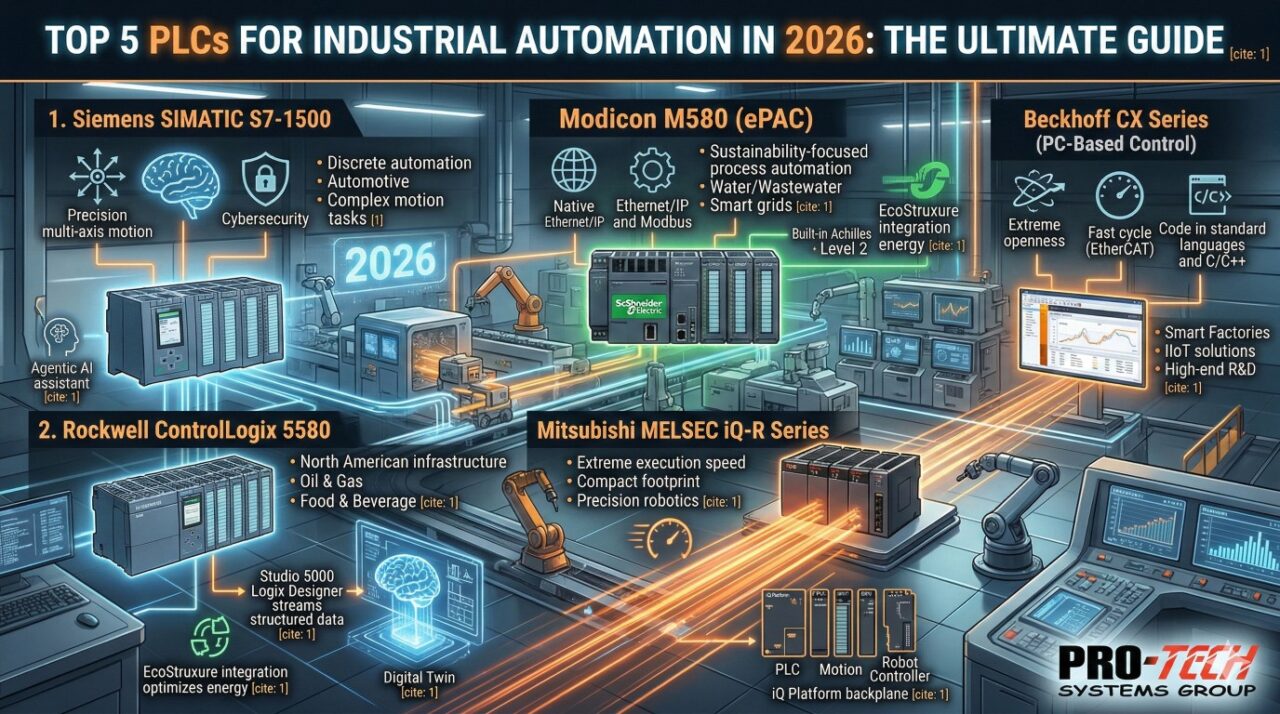
1. Siemens SIMATIC S7-1500 (and S7-1200 G2)
Siemens continues to set the global benchmark for high-end, discrete manufacturing. With the recent release of the S7-1200 G2 and further enhancements to the flagship S7-1500, Siemens has doubled down on Software-Defined Automation, making it a top contender for any industrial automation PLC strategy.
- Key Strength: Integrated Motion Control and Cybersecurity.
- Unique Feature: The TIA Portal environment unifies PLC, HMI, and Drive programming into a single framework. For 2026, Siemens has integrated Agentic AI assistants within the portal to help engineers debug code in real-time.
- Best For: Large-scale European and Asian manufacturing, automotive lines, and complex multi-axis motion tasks found in discrete automation.
2. Rockwell Automation: Allen-Bradley ControlLogix 5580
For North American operations, the Allen-Bradley brand remains the primary choice for an industrial automation PLC. The ControlLogix 5580 series is prized for its plant-wide stability and its massive ecosystem of third-party Encompass partners.
- Key Strength: High availability and ease of integration in North American infrastructure.
- Unique Feature: Studio 5000 Logix Designer allows for seamless multi-discipline control. In 2026, Rockwell’s focus is on FactoryTalk DataMosaix, which helps the PLC stream structured data directly to cloud-based Digital Twins.
- Best For: Oil & Gas, Food & Beverage, and facilities requiring long-term legacy support and 24/7 uptime.
3. Schneider Electric: Modicon M580 (ePAC)
Schneider Electric has branded the M580 as the world’s first ePAC (Ethernet Programmable Automation Controller). This platform is built entirely on an Ethernet backbone, making it a leader in industrial automation PLC options for process-heavy industries.
- Key Strength: Native Ethernet/IP and Modbus TCP/IP integration.
- Unique Feature: EcoStruxure integration. The M580 features built-in cybersecurity (Achilles Level 2) and is designed specifically to optimize energy consumption—a major KPI for 2026 sustainability mandates.
- Best For: Water/Wastewater treatment, smart grid utilities, and sustainability-focused process automation.
4. Mitsubishi Electric: MELSEC iQ-R Series
Mitsubishi dominates the high-speed precision sector, particularly in electronics and semiconductor assembly. When execution speed is the primary metric for your industrial automation PLC, the iQ-R series is the clear winner due to its multi-CPU capability.
- Key Strength: Execution speed and compact footprint.
- Unique Feature: The iQ Platform allows a PLC CPU, a Motion CPU, and even a Robot Controller to sit on the same backplane. This reduces latency to near-zero levels.
- Best For: High-speed packaging, semiconductor fabrication, and precision robotics.
5. Beckhoff: CX Series (PC-Based Control)
While technically an Industrial PC (IPC) running PLC software, Beckhoff has disrupted the market by proving that PC-based control is often more flexible than traditional hardware. It is a favorite for engineers looking for an open-architecture industrial automation PLC.
- Key Strength: Ultra-fast cycle times via EtherCAT and extreme openness.
- Unique Feature: TwinCAT 3 software allows engineers to write PLC code in standard IEC 61131-3 languages or C/C++, making it a favorite for IT-centric engineering teams developing IIoT solutions.
- Best For: Industry 4.0 Smart Factories, vision-integrated sorting, and high-end R&D.
Comparative Summary: 2026 Feature Matrix
| Feature | Siemens S7-1500 | Rockwell ControlLogix | Schneider M580 | Mitsubishi iQ-R | Beckhoff CX |
|---|---|---|---|---|---|
| Primary Region | Global / Europe | North America | Global / Process | Asia / Global | Europe / Global |
| Programming | TIA Portal | Studio 5000 | EcoStruxure | GX Works3 | TwinCAT 3 |
| Industry 4.0 | High (OPC UA) | High (Cloud-Native) | High (IIoT Ready) | Medium | Extreme (PC-Based) |
| Best Asset | Integration | Reliability | Energy Efficiency | Speed | Flexibility |
Frequently Asked Questions
Yes. While staying within one ecosystem (like Siemens or Rockwell) simplifies spare parts and training, modern protocols like OPC UA and MQTT allow different brands of industrial automation PLC hardware to communicate seamlessly. However, this requires a skilled systems integrator to manage the architecture.
p>Absolutely. In 2026, we are seeing a shift where the hardware is becoming a commodity, and the value lies in the software. Platforms like Beckhoff and Siemens’ Virtual PLC allow you to run control logic on standard servers or edge gateways, decoupling the industrial automation PLC logic from the physical box.
While the rugged hardware can last 15–20 years, the software support lifecycle is usually 10–12 years. We recommend choosing a platform with a clear migration path to avoid planned obsolescence and ensure your field services team can support it long-term.
More PLC Questions Answered
Which PLC offers the best native OPC UA support for Industry 4.0?
Among the major platforms, the Siemens SIMATIC S7-1500 and Beckhoff controllers provide the most mature native OPC UA server and client support, and Rockwell’s Allen-Bradley ControlLogix 5580 now includes built-in OPC UA on current firmware. All three can publish data directly to MES, SCADA, and IIoT systems without a separate gateway, which is what makes them strong choices for Industry 4.0.
What is the best PLC for industrial automation?
There is no single best PLC; the right choice depends on your industry and existing systems. Rockwell Allen-Bradley is the standard across US water, wastewater, and process plants; Siemens leads in global and OEM manufacturing; Schneider Modicon suits process and hybrid applications; Mitsubishi is strong in high-speed discrete control; and Beckhoff leads in PC-based motion control.
Ready to Optimize Your Control System?
Choosing the right hardware is only half the battle; the real ROI comes from expert programming and system architecture. Whether you are looking to migrate from a legacy system or design a new high-speed line, selecting the right industrial automation PLC is critical.
Our engineers provide vendor-neutral expertise to ensure your facility stays competitive in 2026 and beyond.
Contact Pro-Tech today for a comprehensive system audit and hardware selection consultation.
Related posts