Discrete Automation vs. Process: 7 Critical Differences for Success

Discrete vs Process Automation: 7 Critical Differences for Success
In the vast landscape of industrial manufacturing, choosing the right control strategy is the foundation of efficiency. However, one of the most common points of confusion we encounter is understanding the nuances of discrete vs process automation. While both methodologies aim to improve productivity, safety, and profitability, they are fundamentally different disciplines. They require different software, hardware, and integration strategies to be successful.
Understanding the battle of discrete vs process automation is not just a matter of semantics; it dictates the type of automation solutions you need to buy. Whether you are assembling automotive parts or brewing beverages, applying the wrong methodology can lead to inefficiency, data silos, and costly integration headaches. In this comprehensive guide, we break down the critical differences, the technologies involved, and how to master these concepts in your facility.
Table of Contents
Defining the Contenders: Discrete vs Process Automation
To make an informed decision, we must first clearly define what we mean when we compare discrete vs process automation.
What is Discrete Automation? (The Assembly Line)
Discrete automation is used in manufacturing environments where distinct, countable items are produced. If you can count the products on a conveyor belt (like cars, smartphones, or furniture), you are in the world of discrete manufacturing. The process involves assembling various parts to create a larger, functional entity.
In a discrete environment, the production process can theoretically be stopped and restarted at any time without spoiling the product. The primary goals are usually cycle time reduction, precision assembly, and high-speed packaging. Common applications include:
- Automotive Assembly and Stamping
- Electronics and Semiconductor Manufacturing
- Packaging, Bottling, and Canning
- Machining and Fabrication
To dive deeper into our specific capabilities in this area, visit our dedicated Discrete Automation solutions page.

What is Process Automation? (The Formula)
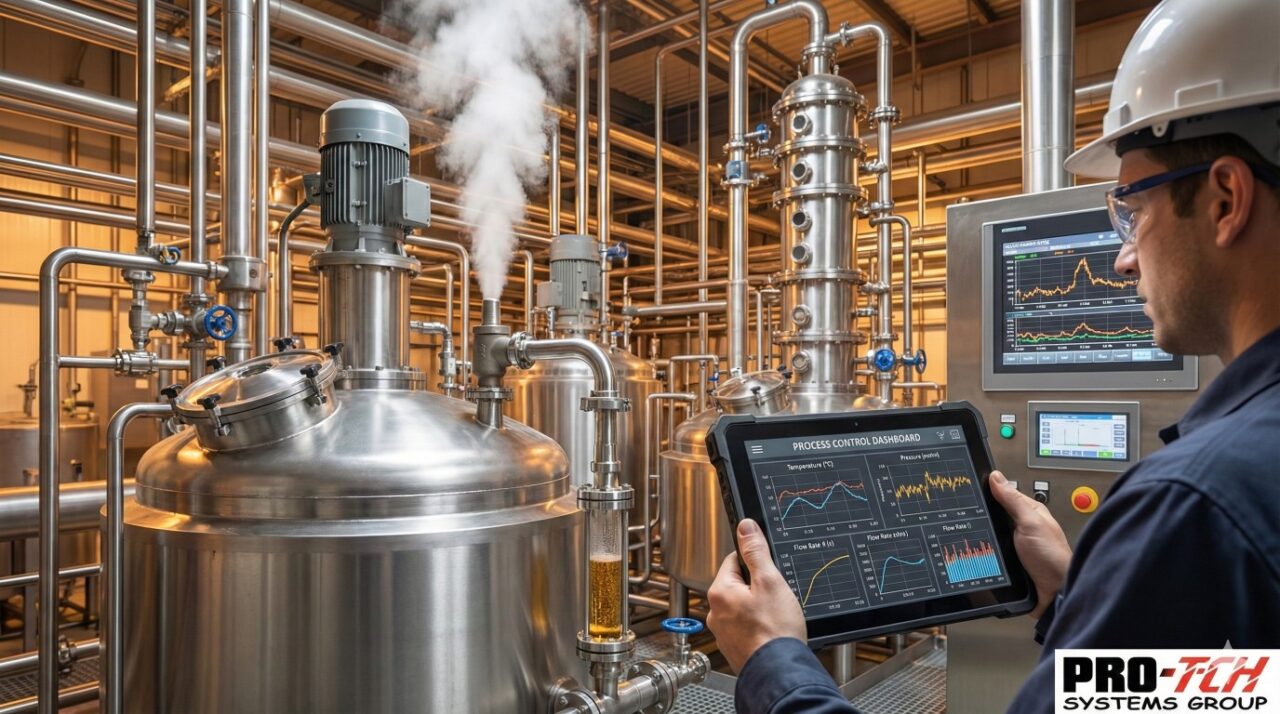
On the other side of the discrete vs process automation divide is process manufacturing. This deals with the production of goods that are measured by volume, weight, or capacity, rather than count. These are typically formulas or recipes—chemicals, oil, gas, beverages, and pharmaceuticals.
Here, the focus is not on “assembly” but on “transformation.” You are managing continuous variables like flow, temperature, pressure, and level. Once a process starts (like a chemical reaction or a fermentation cycle), it often cannot be stopped without ruining the entire batch. You can learn more about this approach on our Process Automation page.
7 Critical Differences: Discrete vs Process Automation
To successfully implement the right strategy, you must understand where they diverge. Here are the seven key differentiators in the discrete vs process automation comparison:
1. The Nature of the Product
This is the simplest test in the discrete vs process automation debate. In discrete automation, the product is solid and distinct (a bolt, a box, a chassis). In process automation, the product is fluid, gaseous, or powder-based (oil, milk, detergent). Even if the final product ends up in a bottle, the creation of the liquid itself is a process application, while the bottling line is a discrete application.
2. The Control System Architecture (PLC vs. DCS)
This is a major technical difference. Discrete automation relies heavily on Programmable Logic Controllers (PLCs). PLCs are designed for high-speed switching and precise motion control, perfect for a robot arm or a conveyor system. Process automation often uses Distributed Control Systems (DCS), which are better at managing complex, slow-moving analog loops like heating a giant tank over several hours. However, modern control systems are increasingly blurring this line with Hybrid Control Systems.
3. Production Flexibility and Changeovers
Discrete systems are often designed for high flexibility. A car factory might switch from producing sedans to SUVs on the same line. The logic in the PLC changes to accommodate different part geometries. Process plants are often designed to run a single product (like a refinery) continuously for months or years, or they run distinct batches where the equipment cleaning (Clean-in-Place or CIP) is as critical as the production itself.
4. Quality Control Metrics
When comparing discrete vs process automation, quality is measured differently. In a discrete environment, quality is measured by tolerances and dimensions. Is the hole drilled within 0.1mm of the spec? Is the label straight? In process environments, quality is measured by chemistry and composition. Is the pH level correct? Is the viscosity within range? Is the temperature consistent?
5. The Consequence of Downtime
If a discrete automation line stops, you lose production time, but the half-assembled widgets sitting on the belt are usually fine. If a process automation system stops unexpectedly, the product inside the pipes might solidify, spoil, or become dangerous. This makes redundancy and Safety Instrumented Systems (SIS) even more critical in process industries to prevent catastrophic failures.
6. Data Complexity and Speed
Discrete automation generates high-speed, binary data (Sensor On/Off, Part Present/Absent). The system makes decisions in milliseconds. Process automation generates massive amounts of analog data (temperature trends over time) that must be logged for regulatory compliance, often requiring robust SCADA integration to visualize trends.
7. The Role of IIoT
While the Industrial Internet of Things benefits both, the application differs in discrete vs process automation. In discrete, IIoT is heavily used for predictive maintenance on motors and robotics to prevent mechanical failure. In process, it is used to monitor environmental compliance, detect leaks, and optimize energy usage. According to Automation.com (ISA), the convergence of these data streams is the future of smart manufacturing.

The Hybrid Industry: Where Worlds Collide
It is important to note that many modern facilities are “hybrid.” A brewery is a perfect example of discrete vs process automation working together. The brewing of the beer is a strict process application (temperature, flow, mixing). However, once the beer is brewed, it moves to the bottling and packaging hall. Here, the logic switches to high-speed discrete automation to fill, cap, label, and box the bottles.
This requires a systems integrator who understands both worlds. You need a partner who can program a DCS to manage the boil kettle and a PLC to run the high-speed filler, ensuring they talk to each other seamlessly through a unified network architecture.
Choosing the Right Partner for Your Automation Journey
Whether you are upgrading a single assembly cell or designing a complete greenfield facility, understanding the nuances of discrete vs process automation is vital for project success. At Pro-Tech Systems Group, we bridge the gap between process and discrete, providing unified solutions that cover your entire value chain.
Are you ready to optimize your production line? Contact Pro-Tech today to discuss your specific automation needs with our engineering team.